
Digital megohmmeters get most of the attention these days, but a lot of electricians and technicians still reach for an analog insulation tester on purpose. A sweeping needle shows you resistance trending in real time as it climbs during a test, which makes it easier to catch a slowly rising or unstable reading than watching a digital number jump around. Analog meters also tend to be simpler mechanically, with fewer electronics to fail in rough field conditions. We rounded up the best true analog-dial insulation testers on the market.
All pricing below is pulled live from Amazon through our product widgets, so what you see is the current listing rather than a static number.
As an Amazon Associate, Power Tools Today earns from qualifying purchases. Prices and availability are accurate as of the date shown and are subject to change.
Quick Picks
- Best Overall: Extech 380320 — triple test voltage, compact professional kit
- Best Budget Pick: GuliTech/Sanwa DM509S — genuine Japanese-made analog meter at a lower price
- Best Backlit Display: Triplett MG420 — multiband analog dial readable in low light
- Best for Continuity + Insulation: Hioki 3490 Megohm HiTester — adds a 3-ohm continuity range
- Best Premium/Compliance-Grade: Kyoritsu 3132A — meets IEC safety standards for documented testing
Quick Comparison: Key Specs
| Model | Test Voltages | Insulation Range | Best For |
|---|---|---|---|
| Extech 380320 | 250V/500V/1000V | Up to 400 MΩ | Compact, well-rounded professional kit |
| GuliTech/Sanwa DM509S | 500V (single range) | Up to 1000 MΩ | Lower-cost genuine analog meter |
| Triplett MG420 | 250V/500V/1000V | Up to 400 MΩ | Backlit dial for dim work areas |
| Hioki 3490 | 250V/500V/1000V | Up to 4000 MΩ | Insulation + continuity in one tool |
| Kyoritsu 3132A | 250V/500V/1000V | Up to 400 MΩ | Documented, standards-compliant testing |
Specs above are manufacturer-published ratings for reference. Pricing in the product boxes below is live and may differ from the table at the time you’re reading this.
1. Extech 380320 Analog Insulation Tester — Best Overall

The Extech 380320 packages three of the most commonly needed test voltages — 250V, 500V, and 1000V — into a genuinely pocket-friendly meter that weighs about 1.2 lb (546 g). The large analog dial is the real selling point here: instead of watching a digital readout jump around, you get continuous visual feedback as resistance climbs, which makes it easier to spot an unstable or slowly-degrading reading. A lock power-on feature frees up your hands during longer tests, and the complete kit ships with a hard carrying case, leads, clips, and batteries so it’s ready to use out of the box.
| Pros | Cons |
|---|---|
| Three test voltages cover most common jobs | Pricier than basic single-range analog meters |
| Genuinely compact and lightweight for a full-featured meter | 400 MΩ max range is lower than digital alternatives |
| Complete kit with hard case included | Analog dial has less fine-grained precision than a digital number |
2. GuliTech/Sanwa DM509S — Best Budget Pick

Sanwa has a long track record in test instrumentation, and this single-range 500V analog megohmmeter brings genuine build quality to the entry-level price point. It’s intentionally simple — one test voltage, a push-switch for one-shot or continuous measurement, and an auto-discharge function for safety — which keeps the learning curve short for anyone who just needs reliable 500V insulation checks without paying for voltage ranges they won’t use.
| Pros | Cons |
|---|---|
| Established Japanese test-instrument brand | Single 500V range only, no multi-voltage flexibility |
| Simple, focused design with a short learning curve | Lighter accessory bundle than pricier kits |
| Auto-discharge function adds a safety layer | Limited stock availability at times |
3. Triplett MG420 Analog Insulation Resistance Tester — Best Backlit Display

Triplett MG420 Analog Insulation Resistance Tester
Working in a dim electrical room or crawlspace is where the Triplett MG420 pulls ahead — its backlit multiband analog display with zero adjust stays readable when other analog dials would be hard to see clearly. It covers the same 250V/500V/1000V range as most competitors, adds AC voltage and low-resistance measurement, and includes a live circuit LED indicator plus lock-power feature for hands-free extended testing.
| Pros | Cons |
|---|---|
| Backlit dial stays readable in dim environments | Stock is often limited on this model |
| Adds AC voltage and low-resistance measurement | Mid-pack price for a mid-pack 400 MΩ range |
| Live circuit LED indicator adds a safety check | Bulkier than the pocket-sized Extech option |
4. Hioki 3490 Analog Megohm HiTester — Best for Continuity + Insulation
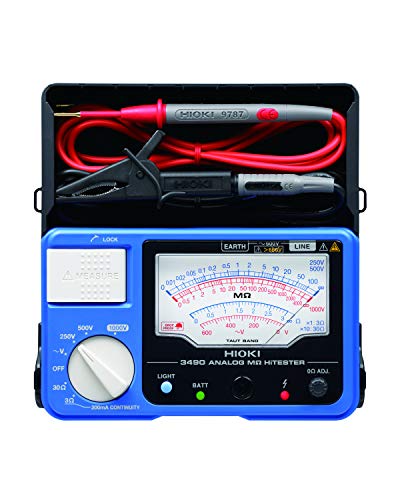
The Hioki 3490 stands out with a genuinely broad 4000 MΩ measurement ceiling on the 1000V range, well beyond what most analog meters in this category offer, plus a dedicated 3-ohm continuity check at 200mA. That combination means you can verify both insulation resistance and basic circuit continuity without switching instruments — a real convenience for anyone doing general electrical troubleshooting alongside insulation checks.
| Pros | Cons |
|---|---|
| 4000 MΩ range far exceeds most analog competitors | Limited stock availability |
| Built-in continuity check adds real versatility | Simple 3-step operation trades some flexibility for ease |
| Bright LED luminous scale for easy reading | Higher price than basic single-range meters |
5. Kyoritsu 3132A Analog Insulation and Continuity Tester — Best Premium/Compliance-Grade

Kyoritsu 3132A Analog Insulation and Continuity Tester, 250/500/1000 Voltage
Kyoritsu built this one to meet formal IEC safety standards — IEC 61010-1, IEC 61557-1/2/4, IEC 60529 (IP54), and IEC 61326-1 (EMC) — with a CAT III 600V installation rating, making it the pick for technicians who need documented, standards-compliant testing rather than just a general-purpose field check. It automatically discharges residual voltage from the test circuit when you release the button — an important safety detail that’s easy to overlook on cheaper meters — and includes an audible live-circuit warning buzzer alongside the visual neon-lamp indicator.
| Pros | Cons |
|---|---|
| Meets multiple formal IEC safety standards | Highest price point of the analog meters here |
| Auto-discharge and audible live-circuit warning | Stock availability is often limited |
| Test button lock for extended measurement sessions | Overkill if you just need occasional spot checks |
Things to Consider Before You Buy
Analog and digital insulation testers measure the same underlying value, so the choice mostly comes down to how you prefer to read the result. A sweeping needle makes it easier to visually track a resistance value that’s slowly rising or fluctuating — useful for judging insulation condition in real time rather than just reading a final number. Digital meters, by contrast, give you more precision and often add features like automatic PI/DAR calculation that analog dials can’t replicate.
If you need documented, standards-compliant results for compliance or safety audits, prioritize a meter with published IEC or EN safety certifications, like the Kyoritsu 3132A. For general field use and routine spot-checking, a simpler multi-voltage analog meter like the Extech 380320 or Triplett MG420 covers the vast majority of real-world testing needs without the added cost of compliance certification you may not require.
Related Guides
- Best multimeter
- Best multimeters for electricians
- Best Fluke multimeters
- How to test a motor with a multimeter
FAQ
Why choose an analog insulation tester over a digital one?
Many technicians prefer the continuous visual feedback of a sweeping needle, especially for judging trends or catching an unstable reading. Analog meters are also mechanically simpler, which some users find more reliable in rough field conditions.
What test voltage should I use?
The correct insulation-test voltage depends on the equipment’s rated voltage, insulation system, manufacturer guidance, and the applicable standard. 250V, 500V, and 1000V are common tester settings, but do not choose one by rule of thumb alone; use the specified procedure for the equipment being tested.
Do analog insulation testers need batteries?
These analog insulation testers are battery-powered, but the required battery type and battery-check features vary by model. Confirm the exact power requirements in the manual or product specification before use.
Prices and availability shown above are pulled live from Amazon and can change at any time. Always confirm the current price and specs on the product page before purchasing.