
As an Amazon Associate, Power Tools Today earns from qualifying purchases. Prices and availability are accurate as of the date shown and are subject to change.
Best Fluke multimeter by job: choose the Fluke 117 for residential/commercial electrical work where LoZ and non-contact voltage detection matter; the 87V for industrial troubleshooting and VFD environments; the 116 for HVAC/R; and the 289 when logging and trend analysis are central to the job. The right model depends more on measurement functions and CAT rating than on buying the most expensive meter.
The challenge in 2026 isn’t finding a good Fluke multimeter — it’s finding the right one from a lineup that spans more than 30 models and a price range from entry-level to premium professional. The Fluke 107 and the Fluke 289 are both called “Fluke multimeters,” but they’re separated by completely different capabilities, user bases, and price points. Buy the wrong one and you either overpay for features you’ll never use, or find yourself missing the one measurement capability that your job actually demands.
This guide covers the 10 best Fluke multimeters in 2026, clearly matched to the users and trades they’re designed for — with a buyer’s guide that explains what Fluke’s model numbers actually mean, the key features that matter for real work, and a direct comparison of the two models that get debated most: the Fluke 117 vs. the Fluke 87V.
Quick Answer: The Fluke 117 is the best Fluke multimeter for most electricians — True RMS, LoZ, NCV, and Fluke reliability in a compact professional package. For serious industrial and diagnostic work, the Fluke 87V is the professional standard with ±0.05% DC accuracy and industrial troubleshooting features. On a budget, the Fluke 107 is the most accessible Fluke that still delivers genuine Fluke quality for home and light professional use.
Quick Picks: Best Fluke Multimeters (2026)
| # | Product | Badge | Best For | Link |
|---|---|---|---|---|
| 1 | Fluke 117 Electrician’s True-RMS Multimeter | 🏆 Best Overall / Best for Electricians | Licensed electricians, residential & commercial wiring | Check Price |
| 2 | Fluke 87V Industrial True-RMS Multimeter | ⚡ Best Industrial / Best Professional | Industrial maintenance, motors, VFDs, precision diagnostics | Check Price |
| 3 | Fluke 179 True-RMS Multimeter | 💰 Best Value Professional Fluke | Electricians & technicians wanting full-feature True RMS with temperature | Check Price |
| 4 | Fluke 289 True-RMS Data Logging Multimeter | 📊 Best for Data Logging & Automotive | Engineers, automotive technicians, predictive maintenance | Check Price |
| 5 | Fluke 116 HVAC True-RMS Multimeter | ❄️ Best for HVAC Technicians | HVAC/R technicians — microamps, temperature, capacitance | Check Price |
| 6 | Fluke 115 Field Technician True-RMS Multimeter | 🔧 Best Compact Field Meter | Field service technicians, daily compact carry | Check Price |
| 7 | Fluke 87V MAX Rugged Industrial Multimeter | 🛡️ Best for Harsh Environments | Industrial sites, oil & gas, outdoor work — IP67, 4m drop | Check Price |
| 8 | Fluke 107 Palm-Sized Multimeter | 💡 Best Budget Fluke | Homeowners, DIYers, light professional use | Check Price |
| 9 | Fluke 77 IV General Purpose Multimeter | 🎓 Best for Beginners & Apprentices | Apprentice electricians, students, introductory professional use | Check Price |
| 10 | Fluke 28 II Rugged Industrial Multimeter | 🏗️ Best Extreme-Environment Fluke | Mining, outdoor construction, highly contaminated environments (IP67) | Check Price |
Full Comparison Table
| Model | True RMS | Max Voltage | DC Accuracy | LoZ Mode | Temp | Min/Max Logging | IP Rating | Drop Rating | Safety Rating | Key Use Case |
|---|---|---|---|---|---|---|---|---|---|---|
| Fluke 117 | ✅ | 600V | ±0.5% | ✅ | No | Yes | IP30 | 1m | CAT III 600V / CAT IV 300V | Residential/commercial electrical |
| Fluke 87V | ✅ | 1,000V | ±0.05% | No | ✅ | Min/Max | IP30 | 1m | CAT III 1000V / CAT IV 600V | Industrial, motors, VFDs |
| Fluke 179 | ✅ | 1,000V | ±0.09% | No | ✅ | Yes | IP40 | 1m | CAT III 1000V / CAT IV 600V | General professional use |
| Fluke 289 | ✅ | 1,000V | ±0.025% | ✅ | ✅ | Yes (TrendCapture + time-stamp) | IP40 | 1m | CAT III 1000V / CAT IV 600V | Engineering, automotive, logging |
| Fluke 116 | ✅ | 600V | ±0.5% | No | ✅ | Yes | IP30 | 1m | CAT III 600V / CAT IV 300V | HVAC/R technicians |
| Fluke 115 | ✅ | 600V | ±0.5% | No | No | Yes | IP30 | 1m | CAT III 600V / CAT IV 300V | Field service, compact daily carry |
| Fluke 87V MAX | ✅ | 1,000V | ±0.05% | No | ✅ | Min/Max | IP67 | 4m | CAT III 1000V / CAT IV 600V | Harsh outdoor/industrial environments |
| Fluke 107 | No (Avg-resp) | 600V | ±1.0% | No | No | Yes | IP40 | 1m | CAT III 600V / CAT II 1000V | Homeowner, DIY, light use |
| Fluke 77 IV | No (Avg-resp) | 750V | ±0.3% | No | No | Yes | IP40 | 1m | CAT III 750V / CAT IV 600V | Beginners, apprentices, students |
| Fluke 28 II | ✅ | 1,000V | ±0.09% | No | ✅ | Min/Max | IP67 | 3m | CAT III 1000V / CAT IV 600V | Mining, extreme outdoors (MSHA cert.) |
Who Is This For?
If you’re a licensed electrician doing residential and commercial wiring → The Fluke 117 is the industry-standard pick for your trade. Its LoZ mode eliminates ghost voltages that plague modern wiring, the built-in VoltAlert NCV tip gives you a quick non-contact check before probe contact, and True RMS handles the non-sinusoidal loads you encounter daily. It’s the most recommended Fluke among electricians for a reason.
If you do industrial maintenance, motor drives, VFDs, or complex diagnostic work → The Fluke 87V is the professional standard. Its ±0.05% DC accuracy, timestamped Min/Max recording, and dual-display for simultaneous frequency and voltage measurement on VFD-driven motors are features that separate it from many lower-tier Fluke models. The 87V has been the go-to for industrial electricians and maintenance technicians for two decades.
If you’re an HVAC/R technician → The Fluke 116 was specifically engineered for your trade, with microamp measurement for flame sensor diagnostics, temperature measurement, capacitance for capacitor testing, and all the standard electrical measurements — in one meter purpose-built for heating and cooling work.
If you need a data-logging or automotive diagnostic meter → The Fluke 289 is the top of Fluke’s handheld lineup, with TrendCapture graphing, on-meter TrendCapture logging, ±0.025% DC accuracy, and FlukeView Forms compatibility for professional reporting. It’s the choice for engineers, automotive technicians, and anyone doing predictive maintenance where recording long-term trends is as important as spot measurements.
If you’re a homeowner, student, or apprentice who wants genuine Fluke quality on a budget → The Fluke 107 (pocket-sized and budget-oriented) or Fluke 77 IV (beginner-friendly with analog-style readability) give you Fluke’s safety standards and durability at an accessible price. Neither is True RMS, but both handle the measurements most beginners and homeowners actually make.
How We Chose These Fluke Multimeters
Selecting the best Fluke multimeters required more than listing all available models — it required matching each meter to the trade or use case it genuinely serves best. We evaluated the complete Fluke multimeter lineup against: True RMS capability and its practical impact on specific measurements, DC accuracy and its relevance to the target user, CAT safety ratings and their match to likely working environments, trade-specific features (microamps for HVAC, VFD measurement for industrial, LoZ for electricians), data logging capability for diagnostic work, IP and drop protection for field conditions, and value for money within each user category.
We cross-referenced recommendations from professional electrical forums including Electrician Talk and DIY Solar Forum, Fluke’s own trade-specific guidance for electricians, HVAC technicians, and industrial maintenance professionals, and long-term user reviews from verified purchasers. We specifically excluded models that are discontinued, regionally limited, or serve such specialized purposes (calibration, process measurement, insulation testing) that they belong in a different product category entirely.
We also looked at the most common mistakes buyers make when selecting a Fluke — particularly the over-purchase trap (buying a high-end Fluke with features you’ll never use) and the under-purchase trap (buying a budget model that lacks the one feature your specific trade requires). Both are addressed directly in the buyer’s guide and decision guide below.
Last Updated: March 2026
Buyer’s Guide: How to Choose the Right Fluke Multimeter
1. True RMS — Required for Professionals, Optional for Homeowners
True RMS measurement accurately calculates the actual power of any AC waveform — pure sine waves, modified sine waves, and the distorted waveforms produced by variable frequency drives (VFDs), inverters, and electronic loads. An average-responding meter (like the Fluke 107 and 77 IV) assumes a pure sine wave and introduces 5–40% measurement error on non-sinusoidal loads. For residential electrical work where you’re mostly measuring clean 60Hz mains voltage, average-responding meters are adequate. For any work involving motors, drives, inverters, dimmers, switching power supplies, or variable loads — True RMS is not optional. The Fluke 117, 87V, 179, 289, 115, 116, 87V MAX, and 28 II all include True RMS. The Fluke 107 and 77 IV do not.
2. LoZ Mode — The Electrician’s Ghost Voltage Eliminator
LoZ (Low Impedance) mode loads the circuit with a low-impedance path when measuring voltage, collapsing any phantom voltages from capacitive coupling to near zero. Ghost voltages are extremely common in modern electrical work — a long run of dead wire running parallel to a live circuit can appear to carry voltage on a standard high-impedance meter. Without LoZ, you might spend an hour troubleshooting a “live” circuit that isn’t energized. With LoZ, a ghost voltage collapses immediately while a real voltage stays. The Fluke 117, 289, and Fluke 113 have LoZ mode. The 87V, 179, 115, 116, and others do not — worth knowing if ghost voltages are a regular problem in your work. Our full guide on how to use a voltage tester covers the safe workflow for voltage verification before working on circuits.
3. DC Accuracy — Matters More Than You Think
Fluke’s multimeter lineup spans DC accuracy from ±0.025% (Fluke 289) to ±1.0% (Fluke 107). For most electrical work — measuring 120V AC outlets, checking 12V DC battery voltage, testing continuity — the difference between these accuracy levels is imperceptible in practice. But for battery state-of-charge assessment (where a 0.1V difference matters), precision motor current measurements, or calibration verification, accuracy becomes genuinely important. Match the accuracy to what you’re actually measuring: for standard electrical work, ±0.5% is plenty. For precision diagnostics, ±0.05%–±0.1% makes a real difference.
4. Safety Rating — Match It to Your Work Environment
Fluke multimeters are rated against IEC 61010 overvoltage categories. CAT II covers outlets, appliances, and equipment up to 600V. CAT III covers fixed building wiring, panels, and three-phase distribution at up to 1,000V. CAT IV covers service entrances, outdoor lines, and primary overcurrent protection at up to 1,000V. Almost all Fluke multimeters carry dual CAT ratings — for example, the Fluke 117 is CAT III 600V / CAT IV 300V, while the Fluke 87V is CAT III 1,000V / CAT IV 600V. For residential electrical work: CAT III 600V minimum. For industrial and commercial high-voltage work: CAT III 1,000V. For utility service entrance work: CAT IV 600V minimum.
5. Min/Max Recording and TrendCapture Logging
Min/Max recording stores the highest and lowest values seen since last reset — essential for catching intermittent connection faults, production dips, or voltage fluctuations that aren’t present when you’re standing there with a probe. Every professional Fluke on this list includes Min/Max. TrendCapture goes further — the Fluke 289 plots Min/Max as a trend graph directly on the meter’s display, letting you visualize changes over time without a computer. For the Fluke 87V, timestamped Min/Max recording logs when each extreme occurred. For predictive maintenance and intermittent fault hunting, these are the features that separate Fluke from basic meters.
6. Display Resolution (Counts) — More Counts, More Detail
Display counts determine the finest resolution the meter can display. A 6,000-count meter reading 120.0V can distinguish 0.1V increments. A 50,000-count meter (Fluke 289) reading 119.85V can distinguish 0.01V. For most electrical work, 6,000 counts is adequate. For battery SOC monitoring, precision motor measurements, or anything where small differences matter, higher counts add real value. Fluke’s lineup ranges from 6,000 counts (117, 115, 116, 179) to 50,000 counts (289).
7. Temperature Measurement
Temperature measurement via a K-type thermocouple probe is available on the Fluke 87V, 179, 289, 116, 87V MAX, and 28 II. It’s missing from the 117, 115, 107, and 77 IV. For HVAC work (pipe temperatures, heat exchanger deltas, refrigerant line temperatures), temperature measurement is essentially required. For industrial work (motor bearing temperatures, hot spot identification), it’s extremely useful. For standard residential electrical work, it’s rarely needed — another reason the 117 can omit it without sacrificing much for its target user.
8. IP Rating and Drop Protection — For Outdoor and Harsh Site Work
Most standard Fluke multimeters are rated IP30 or IP40 — basic dust resistance and no water resistance. This is adequate for most indoor electrical work. For outdoor use, construction sites, industrial plants with coolant or cutting fluid, or any environment where the meter is likely to get wet or dropped from a significant height, the IP67-rated models matter. The Fluke 87V MAX and 28 II are both fully sealed (IP67: dustproof and waterproof to 1m for 30 minutes) and survive 3–4 meter drops — appropriate for steel mill work, outdoor solar installations, mining, and construction environments. The standard 87V is only IP30 and survives 1m drops — which is fine for most indoor industrial environments.
9. Fluke Connect Wireless (FC Models)
Several Fluke meters are available in “FC” (Fluke Connect) wireless variants that log measurements directly to your smartphone or tablet via the Fluke Connect app, and connect with other Fluke FC accessories for remote monitoring. The Fluke 289 FC version includes this capability. FC is genuinely useful for industrial maintenance teams doing remote monitoring, documenting commissioning data, or building historical maintenance records. For most individual electricians and technicians, the base non-FC model is adequate — FC adds cost without adding much for single-person field work.
10. Lifetime Warranty — A Real Fluke Differentiator
Fluke backs virtually every professional multimeter in its lineup with a limited lifetime warranty. In practice, this means that if your Fluke 87V develops a fault from normal use, Fluke will repair or replace it. This warranty is genuinely honored — professional electricians routinely cite getting 15–20-year-old Fluke meters repaired or replaced. For meters you carry every day and depend on for safety-critical measurements, a lifetime warranty from a manufacturer that actually honors it is a meaningful differentiator over budget alternatives.
Top 10 Fluke Multimeter Reviews (2026)
1. Fluke 117 Electrician’s True-RMS Multimeter — Best Overall

Verdict: The Fluke 117 is the most recommended Fluke multimeter for electricians working in residential and commercial environments — the one that comes up again and again when professionals ask what to buy. It’s not the most feature-rich Fluke, and it’s not the most accurate. It’s the one that has exactly the features a working electrician needs every day, assembled into a compact, intuitive tool with Fluke’s legendary reliability and a lifetime warranty. True RMS, LoZ for ghost voltages, NCV at the tip, and Min/Max recording cover the core of what every electrician measures daily.
Best For: Licensed residential and commercial electricians, apprentices moving up from a basic meter, HVAC electricians who don’t need microamps. The industry-standard entry-level professional Fluke.
Not Ideal For: Industrial work with motors and VFDs above 600V DC (use the 87V); HVAC technicians who need microamp and capacitor testing (use the 116); anyone needing temperature measurement (neither 117 nor 115 have it).
Key Features: True RMS measurement handles the non-sinusoidal loads that average-responding meters misread — essential when you’re working around dimmers, switching power supplies, and electronic loads. LoZ mode eliminates ghost voltages in long cable runs and multi-wire circuits — a feature the 87V lacks and electricians genuinely need. The built-in VoltAlert NCV sensor at the meter tip allows quick non-contact voltage detection before probe contact — the fastest way to check if a circuit is live while holding a single tool. Auto voltage detection eliminates manual AC/DC selection. Min/Max/Average records peak values. The compact body fits a tool pouch or belt holster without bulk. CAT III 600V / CAT IV 300V covers all residential and most commercial environments. Backed by Fluke’s limited lifetime warranty and the most complete support ecosystem of any meter brand.
| Pros | Cons |
|---|---|
| LoZ mode eliminates ghost voltages — unique in the Fluke lineup | 600V max — not for high-voltage industrial strings |
| Built-in VoltAlert NCV at the tip | No temperature measurement |
| Auto AC/DC voltage selection | No microamps (HVAC users need the 116) |
| True RMS for accurate non-sinusoidal load reading | Narrower display viewing angle than some competitors |
| Limited lifetime Fluke warranty | Premium price vs. non-Fluke alternatives |
| Spec | Value |
|---|---|
| Max Voltage | 600V AC/DC |
| DC Accuracy | ±0.5% |
| True RMS | Yes |
| LoZ Mode | Yes |
| NCV Detection | Yes (tip-mounted) |
| Min/Max/Average | Yes |
| Temperature | No |
| IP Rating | IP30 |
| Safety Rating | CAT III 600V / CAT IV 300V |
| Display | 6,000 counts, LED backlight |
| Warranty | Limited Lifetime |
2. Fluke 87V Industrial True-RMS Multimeter — Best Professional / Best Industrial

Verdict: The Fluke 87V is the meter that industrial electricians, maintenance technicians, and engineers describe as the “industry standard” — and it’s held that reputation for good reason across multiple generations. Its ±0.05% DC accuracy is genuinely rare at this price point, its dual display shows frequency and voltage simultaneously on VFD-driven motors, and its timestamped Min/Max recording logs exactly when each peak or trough occurred. For diagnosing industrial electrical systems where precision and data matter more than LoZ mode, the 87V is the definitive choice.
Best For: Industrial maintenance technicians, senior electricians in commercial/industrial environments, engineers troubleshooting motors, VFDs, and complex systems, and anyone who needs the highest DC accuracy in a handheld Fluke short of the 289.
Not Ideal For: Electricians who primarily need LoZ mode for ghost voltage elimination (use the 117); those who need extreme ruggedness or IP67 sealing (use the 87V MAX or 28 II); homeowners who don’t need the precision or industrial features.
Key Features: The ±0.05% basic DC accuracy is the 87V’s headline spec — about 10× more precise than the Fluke 117’s ±0.5%. This matters for battery SOC monitoring, calibration checking, and any measurement where small differences are meaningful. The dual display simultaneously shows two related values — for example, frequency and voltage on a VFD output — without switching modes. The selectable filter mode smooths out the signal noise on variable frequency drives for stable readings. Timestamped Min/Max recording logs the exact time each peak or trough occurred, making it easier to correlate electrical events with system behavior. Temperature via K-type thermocouple. True RMS for accurate AC measurements on distorted waveforms. 1,000V AC/DC covers industrial systems. CAT III 1,000V / CAT IV 600V is a step up from the 117’s rating. Motor Drive measurement mode specifically designed for VFD applications. Limited lifetime warranty.
| Pros | Cons |
|---|---|
| ±0.05% DC accuracy — 10× better than Fluke 117 | No LoZ mode (use 117 for ghost voltage work) |
| Dual display: simultaneous frequency + voltage | IP30 only — not waterproof or dustproof |
| Timestamped Min/Max recording | Higher price than Fluke 179 for similar field work |
| Motor Drive (VFD) measurement mode | Some users find the filter modes complex to navigate |
| 1,000V / CAT III 1000V rating | Heavier than compact field meters |
| Spec | Value |
|---|---|
| Max Voltage | 1,000V AC/DC |
| DC Accuracy | ±0.05% |
| True RMS | Yes |
| Dual Display | Yes |
| LoZ Mode | No |
| Min/Max (timestamped) | Yes |
| Temperature | Yes (K-type thermocouple) |
| Motor Drive Measurement | Yes (VFD mode) |
| IP Rating | IP30 |
| Safety Rating | CAT III 1000V / CAT IV 600V |
| Warranty | Limited Lifetime |
3. Fluke 179 True-RMS Multimeter — Best Value Professional Fluke

Verdict: The Fluke 179 is one of the most complete full-feature Fluke multimeters in the professional lineup at a price point meaningfully below the 87V — combining True RMS, temperature measurement, 1,000V AC/DC, ±0.09% DC accuracy, and CAT III 1,000V safety in a meter that most electricians and technicians will never outgrow. It’s made in the USA (unlike the 107 and 115), comes with industrial-strength test leads, and carries Fluke’s full lifetime warranty. For professionals who need more than the 117 offers but don’t specifically need the 87V’s VFD measurement mode or dual display, the 179 is frequently the better value pick.
Best For: Electricians and technicians who want a professional full-feature True RMS meter with temperature measurement and 1,000V coverage at a value price. Often described as “the most meter the average electrician actually needs.”
Not Ideal For: Users who specifically need LoZ mode (the 117 is better for ghost voltage work); industrial users who need VFD motor drive measurement (the 87V has dedicated VFD modes); anyone who needs data logging beyond basic Min/Max (the 289 is the logging meter).
Key Features: True RMS with ±0.09% basic DC accuracy sits between the 117 (±0.5%) and 87V (±0.05%) — enough precision for virtually all professional electrical work outside specialized industrial calibration. Temperature measurement via K-type thermocouple probe is included, unlike the 117 and 115. 1,000V AC/DC covers industrial and higher-voltage residential applications the 117 can’t reach. Analog bargraph on the display provides the intuitive response visualization that experienced technicians often prefer for dynamic readings. Min/Max recording. Continuity, frequency, capacitance, diode. Made in the USA — Fluke’s 170-series production is domestic, which some professionals specify as a preference. IP40 gives slightly better dust protection than the IP30 of the 117. Limited lifetime Fluke warranty with Fluke’s full US service network.
| Pros | Cons |
|---|---|
| ±0.09% DC accuracy — better than 117, close to 87V | No LoZ mode for ghost voltage elimination |
| Temperature measurement included | No dual display or VFD motor drive mode |
| 1,000V AC/DC for broader coverage | More expensive than the Fluke 117 |
| Made in USA (170-series domestic production) | No built-in NCV detection |
| Comes with industrial-strength test leads | Logging limited to basic Min/Max (no TrendCapture) |
| Spec | Value |
|---|---|
| Max Voltage | 1,000V AC/DC |
| DC Accuracy | ±0.09% |
| True RMS | Yes |
| Temperature | Yes (K-type thermocouple) |
| Analog Bargraph | Yes |
| Made in USA | Yes |
| IP Rating | IP40 |
| Safety Rating | CAT III 1000V / CAT IV 600V |
| Warranty | Limited Lifetime |
4. Fluke 289 True-RMS Data Logging Multimeter — Best for Logging & Engineering

Fluke 289 True-RMS Stand Alone Logging Multimeter
Verdict: The Fluke 289 is the top of Fluke’s handheld DMM lineup for field engineers, automotive diagnosticians, and industrial troubleshooters who need a meter that does more than measure — it records, graphs, timestamps, and reports. The TrendCapture graphing display plots measurement trends directly on the meter screen. Internal memory holds 15,000+ readings with timestamps. The 50,000-count display provides resolution that almost no other handheld can match. LoZ mode, ±0.025% DC accuracy, dual display, and 1,000V coverage round out a meter that essentially replaces multiple tools for complex diagnostic work. It’s expensive — but for the engineer or senior technician who uses it every day, it earns its price.
Best For: Electrical engineers, senior industrial technicians, automotive diagnostic specialists, and anyone who needs to record and analyze measurement data over time rather than just taking spot readings.
Not Ideal For: Electricians who need LoZ as their primary feature (the 117 is simpler and cheaper); anyone who doesn’t need logging or high precision — the 179 or 87V give you most of the field performance at lower cost.
Key Features: TrendCapture graphing is the defining feature — the meter plots Min/Max values as a graph directly on its dot-matrix display, letting you see whether voltage has been trending up or down, whether a fault is intermittent, and when exactly each event occurred. Internal memory stores up to 15,000 readings with timestamps, downloadable via FlukeView Forms software. The 50,000-count dual display simultaneously shows primary and secondary measurements — for example, DC voltage and AC ripple simultaneously on a battery under charge. LoZ mode eliminates ghost voltages, making it the only high-end Fluke on this list that combines LoZ with industrial troubleshooting features. ±0.025% DC accuracy is the highest of any handheld Fluke. Temperature measurement. 1,000V. CAT III 1,000V / CAT IV 600V. Limited lifetime warranty.
| Pros | Cons |
|---|---|
| TrendCapture graphing — unmatched diagnostic power | Highest price of all handheld Fluke DMMs |
| 50,000-count display with ±0.025% DC accuracy | Larger and heavier than compact field meters |
| 15,000+ internal memory readings with timestamps | Significant overkill for basic electrical work |
| LoZ mode + logging in one meter | Not IP67 — no outdoor/wet-environment sealing |
| Dual display: simultaneous primary + secondary | Learning curve for all logging and graphing features |
| Spec | Value |
|---|---|
| Max Voltage | 1,000V AC/DC |
| DC Accuracy | ±0.025% |
| True RMS | Yes |
| LoZ Mode | Yes |
| TrendCapture Logging | Yes (dot-matrix graph display) |
| Internal Memory | 15,000+ readings with timestamps |
| Display | 50,000 counts, dual display, dot-matrix |
| Temperature | Yes |
| IP Rating | IP40 |
| Safety Rating | CAT III 1000V / CAT IV 600V |
5. Fluke 116 HVAC True-RMS Multimeter — Best for HVAC Technicians

Verdict: The Fluke 116 is the Fluke multimeter purpose-built for HVAC/R technicians — with every measurement an HVAC tech needs built into a single compact tool. Microamp measurement for flame sensor diagnostics, temperature measurement for pipe and air temperature deltas, capacitance for capacitor testing on motor start/run circuits, and True RMS for accurate readings on variable-speed HVAC drives, all in a CAT III 600V rated meter with Fluke’s build quality. If you work on heating and cooling systems daily, the 116 covers your full diagnostic workflow without a second tool.
Best For: HVAC/R technicians, refrigeration service technicians, boiler and furnace service professionals who need microamps, temperature, and capacitance alongside standard electrical measurements.
Not Ideal For: Electricians who don’t need microamp or capacitance measurement — the 117 is a better choice for purely electrical work; not suitable for high-voltage industrial systems (600V max).
Key Features: Microamp measurement is the most HVAC-specific feature — flame rectification sensors in gas furnaces and boilers produce microamp-level DC signals that indicate proper flame sensing. If your meter can’t measure microamps accurately, you can’t properly diagnose flame sensor issues. Temperature measurement via thermocouple covers supply and return air temperatures, refrigerant line temperatures, and heat exchanger delta-T measurements. Capacitance measurement tests HVAC motor run and start capacitors — a common failure point on older HVAC equipment. True RMS handles the modified waveforms from variable-speed ECM motors and inverter-driven compressors. Min/Max recording. Continuity, diode, frequency. CAT III 600V / CAT IV 300V. Compact body for tool pouch carry. Limited lifetime warranty.
| Pros | Cons |
|---|---|
| Microamps — essential for flame sensor diagnostics | 600V max — not for high-voltage industrial work |
| Temperature measurement for HVAC diagnostics | No LoZ mode for ghost voltage elimination |
| Capacitance for motor capacitor testing | No built-in NCV detection |
| True RMS for variable-speed HVAC drives | Less versatile than 117 for purely electrical work |
| Purpose-built for HVAC trade requirements | Microamps and capacitance wasted on non-HVAC users |
| Spec | Value |
|---|---|
| Max Voltage | 600V AC/DC |
| DC Accuracy | ±0.5% |
| True RMS | Yes |
| Microamps | Yes (600µA AC/DC) |
| Temperature | Yes (thermocouple) |
| Capacitance | Yes |
| IP Rating | IP30 |
| Safety Rating | CAT III 600V / CAT IV 300V |
| Warranty | Limited Lifetime |
6. Fluke 115 Field Technician True-RMS Multimeter — Best Compact Field Meter

Verdict: The Fluke 115 is the compact, stripped-down sibling of the 117 — True RMS accuracy, excellent LED backlight for outdoor visibility, and Fluke durability in a slightly slimmer body, at a modest discount from the 117’s price. The trade-off is the absence of LoZ mode and the built-in VoltAlert NCV tip. For field service technicians whose primary concern is portability and who work in environments where ghost voltages are not a significant issue, the 115 hits the right balance. Fluke itself recommends it as their standard field service technician meter.
Best For: Field service technicians in telecom, elevator maintenance, building automation, and other trades where compact portability and True RMS accuracy are prioritized over LoZ or NCV detection.
Not Ideal For: Electricians who encounter ghost voltages regularly (use the 117); HVAC technicians who need microamps and temperature (use the 116); industrial work above 600V (use the 87V or 179).
Key Features: True RMS for accurate readings on inverters, switching power supplies, and non-sinusoidal loads. The large white LED backlight is one of the most visible in the Fluke lineup — excellent for reading the display in direct outdoor sunlight and dark service environments. The compact body is noticeably smaller and lighter than the 87V or 179, making it practical for one-handed operation while the other hand manages the circuit. Min/Max/Average recording. Continuity, frequency, capacitance, diode. Auto-ranging. CAT III 600V / CAT IV 300V. The 115 and 117 are the two models Fluke themselves cite as “best all-around workshop tools” on the Fluke website. Limited lifetime warranty.
| Pros | Cons |
|---|---|
| Most compact Fluke True-RMS field meter | No LoZ mode (use 117 for ghost voltage work) |
| Outstanding LED backlight for outdoor use | No NCV detection built in |
| True RMS for non-sinusoidal loads | No temperature measurement |
| Slightly lower price than Fluke 117 | 600V max only |
| Fluke’s recommended field service meter | No microamps (HVAC users use the 116) |
| Spec | Value |
|---|---|
| Max Voltage | 600V AC/DC |
| DC Accuracy | ±0.5% |
| True RMS | Yes |
| LoZ Mode | No |
| Min/Max/Average | Yes |
| IP Rating | IP30 |
| Safety Rating | CAT III 600V / CAT IV 300V |
| Warranty | Limited Lifetime |
7. Fluke 87V MAX Industrial Rugged Multimeter — Best for Harsh Environments

Verdict: The Fluke 87V MAX is the 87V built for the jobs where even a quality meter gets beaten up — steel mills, foundries, outdoor construction in rain, marine environments, anywhere that involves heavy dust, metal shavings, coolant, or regular drops from height. Everything the 87V does (±0.05% DC accuracy, VFD motor measurement, dual display, timestamped Min/Max, 1,000V), but in a fully sealed IP67 body with a 4-meter drop rating, a buoyant holster, and glow-in-the-dark buttons for low-light operation. If you’re in a rough environment, the IP67 seal is worth the premium over the standard 87V.
Best For: Industrial maintenance technicians at steel mills, foundries, petrochemical facilities, outdoor construction and solar installation, marine electrical work, or any environment where the standard 87V’s IP30 protection isn’t enough.
Not Ideal For: Office-based or indoor industrial environments where the IP67 sealing adds cost without benefit — the standard 87V is the better value in those settings. Not suitable for intrinsically safe hazardous area classification (use the 28 II Ex for that).
Key Features: IP67 fully sealed — dustproof and waterproof to 1 meter for 30 minutes. The 4-meter drop rating is a significant step above the 1-meter rating of the standard 87V — survivable from most ladder and scaffold working heights. Glow-in-the-dark buttons enable operation in low-light conditions without needing a flashlight. The buoyant holster prevents immediate sinking if the meter ends up in water. All the core 87V capabilities: ±0.05% DC accuracy, VFD motor drive measurement, dual display, timestamped Min/Max, temperature, 1,000V AC/DC. Upgraded false alert detection system for environments with metal dust and debris. CAT III 1,000V / CAT IV 600V. Limited lifetime warranty.
| Pros | Cons |
|---|---|
| IP67 fully sealed — dustproof and waterproof | Higher price than standard 87V |
| 4-meter drop rating vs. 1m on standard 87V | No LoZ mode (same as 87V) |
| Glow-in-the-dark buttons for low-light work | Overkill and overpriced for indoor environments |
| Buoyant holster prevents sinking | Bulkier body than non-MAX Fluke meters |
| All 87V capabilities in rugged housing | Not rated for hazardous area classification (use 28 II Ex) |
| Spec | Value |
|---|---|
| Max Voltage | 1,000V AC/DC |
| DC Accuracy | ±0.05% |
| True RMS | Yes |
| IP Rating | IP67 (dustproof + waterproof 1m/30min) |
| Drop Rating | 4 meters |
| Glow-in-Dark Buttons | Yes |
| Motor Drive (VFD) | Yes |
| Safety Rating | CAT III 1000V / CAT IV 600V |
| Warranty | Limited Lifetime |
8. Fluke 107 Palm-Sized Multimeter — Best Budget Fluke

Verdict: The Fluke 107 is the most accessible Fluke multimeter — a genuine Fluke product at a budget-oriented price point (making it one of the few Fluke meters that competes with budget brands on price). It’s not True RMS, and it lacks the advanced features of the professional lineup, but it carries Fluke’s CAT III 600V safety rating, Fluke’s build quality, and Fluke’s backed warranty in a truly pocket-sized body. For homeowners, light professionals, students, or anyone who wants a meter they can trust for basic measurements without paying for a higher-tier professional model, the 107 is the honest budget Fluke recommendation.
Best For: Homeowners, students, apprentices just starting out, light professionals who need a reliable “beater” meter for occasional use without spending on a professional model. Adam Savage of MythBusters famously carried the Fluke 101 (predecessor to the 107) on set.
Not Ideal For: Professional electricians who need True RMS, LoZ mode, or temperature measurement — for any daily professional use, the 117 is the entry point. Not for VFD or motor drive work.
Key Features: Palm-sized body — the most compact Fluke multimeter — small enough to fit comfortably in a shirt pocket. Auto-ranging eliminates manual range selection. AC/DC voltage to 600V covers all household applications. Resistance, continuity, diode, and frequency cover basic troubleshooting needs. Min/Max recording. IP40 dust protection. The backlit display and ergonomic grip make it usable in most conditions despite the budget-tier feature set. CAT III 600V / CAT II 1,000V safety ratings. The 107 is notable for delivering Fluke’s safety standards at a price that competes with Klein and KAIWEETS budget offerings — which is the real argument for choosing it over a cheaper generic brand when price is the primary concern.
| Pros | Cons |
|---|---|
| Most affordable genuine Fluke multimeter | Not True RMS — average-responding only |
| Truly pocket-sized for maximum portability | No LoZ mode or NCV detection |
| Fluke safety ratings at budget price | No temperature, no microamps, no capacitance |
| Auto-ranging, Min/Max, IP40 | ±1.0% DC accuracy (adequate for home use) |
| Fluke build quality and lifetime warranty | No Fluke Connect wireless |
| Spec | Value |
|---|---|
| Max Voltage | 600V AC/DC |
| DC Accuracy | ±1.0% |
| True RMS | No (average-responding) |
| Min/Max | Yes |
| IP Rating | IP40 |
| Drop Rating | 1m |
| Safety Rating | CAT III 600V / CAT II 1000V |
| Warranty | Limited Lifetime |
9. Fluke 77 IV General Purpose Multimeter — Best for Beginners and Apprentices

Fluke 77-4 Automotive Digital Multimeter
Verdict: The Fluke 77 IV is one of Fluke’s most enduring meters — a model that has been in continuous production across multiple generations, loved by beginners and veterans alike for its clear analog bargraph display, straightforward operation, and rock-solid reliability. Adam Savage of MythBusters showed off a 30-year-old original Fluke 77 that was still working perfectly. The IV generation brings that same reliability to modern safety standards. For apprentice electricians, students entering the trade, and beginners who want a “buy once” entry meter that will outlast cheaper alternatives, the 77 IV is a classic choice.
Best For: Apprentice electricians, trade school students, beginners who want a simple, durable meter from a trusted brand without the complexity of the professional Fluke lineup.
Not Ideal For: Professional use requiring True RMS (the 77 IV is average-responding); modern VFD or inverter work where non-sinusoidal waveforms require True RMS; anyone who has already moved past the basics.
Key Features: The analog bargraph is the 77 IV’s defining display feature — it provides analog-style visual feedback on changing values, helping beginners understand the direction and speed of change more intuitively than a jumping digital number. Auto-ranging with manual override. AC/DC voltage to 750V, current to 10A, resistance, continuity, frequency, and diode testing cover all standard electrical measurements. The 0.3% basic DC accuracy is notably better than the 107 and most budget competitors — more precision than expected for an entry-level Fluke. Min/Max recording. IP40 protection. CAT III 750V / CAT IV 600V safety ratings (a step above some competitors at this price level). Limited lifetime warranty means the 77 IV can genuinely last a career if maintained — exactly the reputation the 77-series has built over decades.
| Pros | Cons |
|---|---|
| Analog bargraph for intuitive reading of changing values | Not True RMS — average-responding only |
| Fluke’s most iconic beginner/apprentice meter | No LoZ mode or NCV detection |
| ±0.3% DC accuracy — better than most budget meters | No temperature, microamps, or capacitance |
| CAT III 750V / CAT IV 600V safety ratings | No HVAC, industrial, or VFD-specific features |
| Proven multi-decade reliability record | Less compact than Fluke 107 |
| Spec | Value |
|---|---|
| Max Voltage | 750V AC / 1,000V DC |
| DC Accuracy | ±0.3% |
| True RMS | No (average-responding) |
| Analog Bargraph | Yes |
| Min/Max | Yes |
| IP Rating | IP40 |
| Safety Rating | CAT III 750V / CAT IV 600V |
| Warranty | Limited Lifetime |
10. Fluke 28 II Rugged Industrial Multimeter — Best Extreme-Environment Fluke
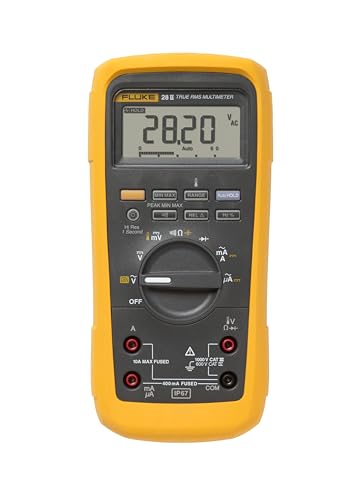
Verdict: The Fluke 28 II is Fluke’s most rugged non-intrinsically-safe industrial multimeter — built to survive environments where the 87V MAX would get destroyed. IP67 sealed, 3-meter drop tested, MSHA certified for mining environments, and capable of surviving underwater submersion that would kill a standard meter. If your work takes you underground, into flooded basements, through torrential rain on a construction site, or into any environment that chews through ordinary meters, the 28 II is the meter that comes back working. Its measurement capabilities match the 179: True RMS, ±0.09% DC accuracy, 1,000V, temperature, and timestamped Min/Max — all in the toughest Fluke body this side of the intrinsically safe 28 II Ex.
Best For: Mining technicians, utility line workers, outdoor construction electricians, infrastructure maintenance teams, and anyone whose meter needs to survive being dropped in water, buried in dust, or dropped repeatedly from height.
Not Ideal For: Intrinsically safe (ATEX/IECEx) hazardous area classification — for oil and gas with explosion risk, use the Fluke 28 II Ex instead. Not cost-justified for normal indoor environments.
Key Features: IP67 dustproof and waterproof sealing survives complete submersion to 1m for 30 minutes — not just splash resistance. 3-meter drop rating handles falls from standing height on hard surfaces. MSHA (Mine Safety and Health Administration) certification confirms it has been tested and approved for use in mining environments — a specific regulatory requirement for some operations. All the core 179/87V performance: True RMS, ±0.09% DC accuracy, 1,000V AC/DC, temperature measurement via K-type thermocouple, timestamped Min/Max recording, and analog bargraph display. CAT III 1,000V / CAT IV 600V safety rating. The armored housing, sealed battery compartment, and robust rubber overmolding are visibly different from standard Fluke meters. Limited lifetime warranty.
| Pros | Cons |
|---|---|
| IP67 — survives submersion up to 1m | Highest price of the rugged models |
| 3-meter drop rating | Not intrinsically safe (use 28 II Ex for ATEX zones) |
| MSHA certified for mining environments | Significantly heavier than standard Fluke meters |
| True RMS + 1,000V + temperature | Overkill and overpriced for indoor environments |
| Full Fluke professional measurement capability | No LoZ mode |
| Spec | Value |
|---|---|
| Max Voltage | 1,000V AC/DC |
| DC Accuracy | ±0.09% |
| True RMS | Yes |
| IP Rating | IP67 (dustproof + waterproof 1m/30min) |
| Drop Rating | 3 meters |
| MSHA Certified | Yes (mining environments) |
| Temperature | Yes (K-type thermocouple) |
| Safety Rating | CAT III 1000V / CAT IV 600V |
| Warranty | Limited Lifetime |
Fluke Model Number Guide — What the Numbers Actually Mean
Fluke’s model numbering system isn’t fully intuitive, but there is a logic to it that helps you navigate the lineup once you understand the pattern. Here’s how to read Fluke DMM model numbers:
Series Number (10s, 70s, 80s, 100s, 170s, 280s): The series roughly indicates the class and feature tier. The 70-series (77 IV) is Fluke’s classic general-purpose entry tier. The 100-series (107, 113, 115, 116, 117) is the current standard professional tier — compact, field-focused meters matched to specific trades. The 170-series (179) is the full-feature professional tier with higher accuracy, made in the USA. The 280-series (289) is the top engineering tier with data logging and the highest accuracy. The 80-series (87V, 87V MAX) sits in the industrial professional tier across accuracy and ruggedness.
Trade-Specific Models Within a Series: Within the 110-series, the last digit indicates trade focus: the 115 is the field service meter, the 116 is the HVAC meter, and the 117 is the electrician’s meter. Different last digits signal that the meter was designed around a specific trade’s measurement priorities. When you see a Fluke 116, the “6” signals HVAC focus; the 117’s “7” signals electrician focus.
“V” Suffix (87V): The “V” in 87V indicates a generation update — the current 87V is the fifth generation of the 87-series. When Fluke updates a model, it appends the version letter rather than changing the series number, maintaining product continuity for customers who specify Fluke 87V in procurement documents.
“FC” Suffix (283 FC, 289 FC): FC stands for Fluke Connect — the wireless measurement logging ecosystem. FC-suffix meters include Bluetooth connectivity for logging to the Fluke Connect smartphone app and connecting with other Fluke FC wireless accessories.
“MAX” Suffix (87V MAX): MAX indicates an enhanced ruggedness variant with IP67 sealing and improved drop rating compared to the base model. Same measurement capabilities, hardened body.
Number Alone (28 II): The Roman numeral indicates generation — the 28 II is the second-generation 28. Fluke uses Roman numerals for some rugged industrial models to distinguish generations without changing the series identification.
Head-to-Head: Fluke 117 vs. Fluke 87V — The Most-Debated Comparison
No two Fluke models get compared more often than the 117 and the 87V — and the debate is legitimate because they’re aimed at genuinely different users. Here’s the definitive side-by-side:
| Feature | Fluke 117 | Fluke 87V |
|---|---|---|
| Primary Trade | Electricians (residential & commercial) | Industrial maintenance & engineers |
| Max Voltage | 600V AC/DC | 1,000V AC/DC |
| True RMS | ✅ Yes | ✅ Yes |
| LoZ Mode (ghost voltages) | ✅ Yes — key differentiator | ❌ No |
| Built-in NCV Detection | ✅ Yes (tip-mounted) | ❌ No |
| DC Accuracy | ±0.5% | ±0.05% — 10× better |
| Temperature Measurement | ❌ No | ✅ Yes (K-type thermocouple) |
| Dual Display | ❌ No | ✅ Yes (simultaneous freq + voltage) |
| VFD Motor Drive Mode | ❌ No | ✅ Yes |
| Min/Max Recording | Yes (basic) | Min/Max |
| CAT Rating | CAT III 600V / CAT IV 300V | CAT III 1000V / CAT IV 600V |
| IP Rating | IP30 | IP30 |
| Price | Lower | Higher (+ more) |
Who should buy the Fluke 117: Electricians doing residential and commercial wiring — panel work, outlet circuits, breaker diagnostics, and any work where ghost voltages (from adjacent live conductors in conduit or multi-wire bundles) are a regular issue. The LoZ mode and NCV tip are daily-use features for electricians that the 87V simply lacks. The 600V maximum covers everything in standard residential and light commercial work. You’re paying less for features that match your trade better.
Who should buy the Fluke 87V: Industrial maintenance technicians, engineers, and anyone working with motors, VFDs, industrial 480V three-phase systems, or any application where ±0.05% DC accuracy matters. The dual display for simultaneous VFD voltage and frequency reading is a feature designed for industrial drive work that has no equivalent in the 117. The 1,000V ceiling provides necessary coverage for industrial systems. If you’re in manufacturing, utilities, or industrial maintenance — the 87V is the right investment.
The honest verdict: For electricians, the 117 is the better tool at a better price. For industrial technicians, the 87V is irreplaceable. Don’t buy the 87V because it “looks more impressive” if you’re doing residential electrical work — you’re paying for features you won’t use and missing LoZ that you would use every day.
Common Mistakes When Buying a Fluke Multimeter
Mistake #1: Buying the 87V When You Need the 117
The Fluke 87V has a reputation as “the best Fluke” that leads many electricians to buy it as a status symbol or aspirational purchase — and then realize they’re missing LoZ mode (which the 117 has and the 87V doesn’t) while using none of the 87V’s industrial-specific features. On Electrician Talk forums, veteran electricians regularly point out that the 87V’s ±0.05% DC accuracy is meaningless for AC-dominant residential work, and that the lack of LoZ mode is a genuine daily inconvenience. Match the meter to your trade, not to the model number’s prestige.
Mistake #2: Assuming the More Expensive Fluke Is Always Better
A Fluke 289 is a more capable meter than a Fluke 117 by almost every objective spec. But for a residential electrician, the 289’s TrendCapture graphing, 50,000-count display, and ±0.025% accuracy are features they’ll never use — while the LoZ mode and NCV tip on the 117 are features they use every single day. The best Fluke is the one designed for your specific trade and tasks, not the one with the highest model number or price.
Mistake #3: Overlooking the Fluke 179 as a Value Option
Many buyers jump from the 117 directly to the 87V when they want “more Fluke,” not realizing the 179 sits between them at a price that often makes more sense. The 179 gives you 1,000V AC/DC, ±0.09% DC accuracy, temperature measurement, and made-in-USA quality at less than the 87V — and more than the 117. For professionals who need more than the 117 offers but don’t specifically need VFD motor measurement or dual display, the 179 is frequently the better choice that gets overlooked.
Mistake #4: Buying a Fluke 107 for Professional Daily Use
The Fluke 107 is a great homeowner and light-use meter — it’s the right tool for that application. But professional electricians who buy it as their primary meter because of the attractive price soon find themselves without True RMS (which produces incorrect readings on dimmers, inverters, and variable loads) and without LoZ mode (which leaves them chasing ghost voltages). For daily professional use, the Fluke 117 is the entry point — the 107 is a homeowner tool wearing a Fluke badge.
Mistake #5: Not Accounting for the Test Leads Quality
Fluke’s professional meters (117, 87V, 179, 289) come with high-quality TL75 or TL175 test leads rated for the meter’s safety category. The Fluke 107 and 77 IV ship with lower-grade leads. Even on professional Fluke meters, many experienced technicians upgrade to premium silicone leads (Fluke TL175 or equivalent) for better flexibility and safety. Never mix leads with mismatched CAT ratings between your meter and leads — the lowest-rated component determines the overall system’s safety rating.
Mistake #6: Ignoring the HVAC-Specific Fluke 116
HVAC technicians frequently buy the Fluke 117 (the most-recommended Fluke) without realizing the Fluke 116 was specifically engineered for their trade. The 116’s microamp measurement for flame sensor diagnostics and capacitance for motor capacitor testing are daily-use HVAC features that the 117 lacks entirely. If you work on heating and cooling systems, the 116 is a better tool for your specific trade than the more popular 117 — and it’s worth knowing that difference before purchasing.
Decision Guide: Which Fluke Is Right for You?
You’re a licensed electrician doing residential and commercial wiring → The Fluke 117 — the industry standard for your trade. LoZ for ghost voltages, VoltAlert NCV at the tip, True RMS, compact body. Before commissioning any circuit, always verify safety using the workflow in our how to use a voltage tester guide.
You’re an industrial maintenance technician working with motors, VFDs, and 480V three-phase systems → The Fluke 87V — dual display for simultaneous VFD measurement, ±0.05% DC accuracy, 1,000V, timestamped Min/Max. For outdoor or harsh industrial environments, upgrade to the Fluke 87V MAX with IP67 and 4-meter drop rating.
You’re an HVAC/R technician → The Fluke 116 — purpose-built for your trade with microamps for flame sensors, temperature, capacitance, and True RMS. Don’t buy the 117 without knowing the 116 exists.
You want a professional full-feature Fluke with temperature and 1,000V, at a better price than the 87V → The Fluke 179 — ±0.09% DC accuracy, 1,000V, temperature, made in USA. Often the best value in Fluke’s professional lineup for general electrical work above the 117’s feature level. A solid companion to our best clamp meters guide for complete electrical diagnostic kit building.
You need data logging, TrendCapture graphing, or the highest precision in a handheld Fluke → The Fluke 289 — TrendCapture, 50,000 counts, ±0.025% DC, 15,000-reading internal memory. For engineers and senior technicians only — it’s overkill for standard field electrical work.
You’re an apprentice, student, or homeowner who wants Fluke quality on a budget → The Fluke 107 — the most affordable genuine Fluke, compact, reliable, safe. Or the Fluke 77 IV for the classic analog bargraph display that helps beginners read changing values intuitively. Before using any multimeter for the first time, read our voltage tester guide for safe electrical measurement practice.
You work in extreme environments — mining, outdoor, heavy industrial → The Fluke 28 II (IP67, MSHA certified, 3m drop) for mining and heavy outdoor use, or the Fluke 87V MAX (IP67, 4m drop) for industrial outdoor environments that don’t need MSHA certification.
Frequently Asked Questions
What is the best Fluke multimeter for electricians?
The Fluke 117 is the best Fluke multimeter for most electricians in 2026. It includes the features electricians use most: LoZ mode for eliminating ghost voltages in multi-wire circuits, built-in VoltAlert NCV detection at the tip, True RMS for accurate non-sinusoidal load readings, and Min/Max recording — all in a compact, professional body at a lower price than the 87V. For commercial or industrial electricians working with voltages above 600V or with motor drives, step up to the Fluke 87V or Fluke 179.
Is the Fluke 87V worth the extra money over the Fluke 117?
For industrial maintenance technicians: yes, absolutely. The 87V’s ±0.05% DC accuracy, dual display, VFD motor drive measurement, and 1,000V ceiling are daily-use industrial features that justify the price premium. For residential and commercial electricians: often no. The 87V lacks LoZ mode (which the 117 has and electricians use constantly), costs significantly more, and adds features the electrical trade rarely needs. Buy the meter designed for your trade, not the one with the higher prestige.
Does the Fluke 107 have True RMS?
No — the Fluke 107 is an average-responding meter, not True RMS. It produces accurate readings on clean 60Hz sine wave AC (standard household current) but introduces measurement error on non-sinusoidal waveforms from dimmers, inverters, VFDs, and switching power supplies. For homeowners measuring standard outlets and household appliances, this is rarely a practical limitation. For professional electrical work involving any variable or electronic loads, True RMS is required — and the Fluke 117 or 115 are the entry-level True RMS Fluke options.
Which Fluke multimeter is best for HVAC?
The Fluke 116 — specifically designed for HVAC/R technicians, with microamp measurement for flame sensor diagnostics, temperature measurement for pipe and air temperature differentials, capacitance measurement for motor capacitor testing, and True RMS for variable-speed drive systems. The more popular Fluke 117 lacks microamp and capacitance measurement — essential HVAC features. If you’re in the HVAC trade, the 116 is purpose-built for you.
What is LoZ mode on Fluke multimeters?
LoZ (Low Impedance) mode connects a low-impedance load across the measurement circuit when checking for voltage. This collapses phantom or ghost voltages — false voltage readings caused by capacitive coupling from nearby live conductors — to near zero. A real voltage source maintains its reading under low impedance load; a ghost voltage disappears. LoZ mode is available on the Fluke 117 and 289, and it’s one of the most practically useful features for electricians working in buildings where multiple circuits share conduit.
How long is the Fluke warranty?
Fluke offers a “limited lifetime warranty” on virtually all its professional multimeters — including the 117, 87V, 179, 289, 115, 116, 87V MAX, 77 IV, and 28 II. In practice, this means Fluke will repair or replace a meter that develops a defect from normal use, at no charge, for the product’s lifetime. Professional electricians routinely describe getting 15–20-year-old meters repaired or replaced under warranty. It’s a genuine, honored warranty that is one of the strongest arguments for Fluke vs. budget alternatives in professional settings.
What is the difference between the Fluke 87V and the Fluke 87V MAX?
The Fluke 87V MAX has the same core measurement capabilities as the 87V (±0.05% DC accuracy, VFD motor drive mode, dual display, 1,000V) but adds IP67 dustproof and waterproof sealing (the base 87V is only IP30), a 4-meter drop rating (vs. 1m for the 87V), glow-in-the-dark buttons for low-light environments, a buoyant holster, and an upgraded false-alert detection system for metal-dust environments. Choose the 87V MAX for outdoor, wet, or heavily contaminated environments; use the standard 87V for typical indoor industrial settings.
Is Fluke worth the money compared to Klein or KAIWEETS?
For professional daily use where measurement confidence and safety matter: yes. Fluke’s consistent accuracy, genuine CAT rating certifications, lifetime warranty, and global support infrastructure justify the premium for professionals who depend on their meter daily. The “measurement confidence” factor — knowing that when your Fluke says dead, it’s dead — has real value in safety-critical environments. For homeowners and occasional use: the value equation shifts. A Klein MM700 or KAIWEETS KM601S at half the Fluke price delivers honest True RMS and solid build quality for non-daily professional use. See our best clamp meters guide for the equivalent analysis of Fluke vs. competitors in clamp meter selection.
Can I use a Fluke 107 for professional electrical work?
For light professional work — occasional outlet checks, basic continuity and resistance measurement, simple voltage verification — yes, the 107’s Fluke safety standards and reliability make it a legitimate professional-use tool. For daily professional electrical work where you regularly encounter non-sinusoidal loads, ghost voltages, or need to rely on “dead circuit” confirmations for safety: no. The 107 lacks True RMS and LoZ mode, which are professional daily-use requirements. The Fluke 117 is the minimum for professional daily electrical use.
What Fluke multimeter should I buy if I’m just starting out?
For a trade apprentice or student entering the electrical or HVAC field: the Fluke 77 IV gives you Fluke safety standards, a beginner-friendly analog bargraph display, and a durable meter that will grow with you for years. For a homeowner who needs a reliable meter for home projects: the Fluke 107 is the most accessible price point with Fluke build quality. Either of these will outlast multiple cheap alternatives and give you genuine Fluke reliability as your first meter.
Final Recommendation
Fluke has built a meter for every trade and every budget in its lineup — the key is matching the right model to your actual work. The 87V isn’t better than the 117 for an electrician, even though it costs more; and the 289 isn’t the right choice for a homeowner, even though it has more features. The best Fluke is the one designed for what you actually do every day.
Best Fluke for licensed electricians: The Fluke 117 — LoZ, NCV, True RMS, compact. The meter that electricians actually need, not the one that looks most impressive.
Best Fluke for industrial professionals and engineers: The Fluke 87V — ±0.05% DC accuracy, VFD mode, dual display, 1,000V. The industrial standard for two decades.
Best value in the professional Fluke lineup: The Fluke 179 — ±0.09% DC accuracy, temperature, 1,000V, made in USA, at a price between the 117 and 87V. Frequently overlooked, consistently excellent.
Best Fluke for HVAC technicians: The Fluke 116 — microamps, temperature, capacitance, True RMS. Purpose-built for your trade.
Best budget Fluke for homeowners: The Fluke 107 — genuinely affordable, genuinely Fluke, and more than enough for home electrical checks and automotive basics.