
Truck batteries often face higher cranking demands than typical car batteries. Most consumer pickups still use 12V electrical systems, including many dual-battery setups wired in parallel, while some heavy-duty and commercial trucks use 24V systems that require a compatible tester. Whether you’re maintaining a personal pickup or keeping a small fleet running, a tester built for truck-sized batteries saves you from misdiagnosing a battery problem as an alternator issue (or vice versa). We rounded up the best options across digital diagnostic testers and traditional fixed-load battery testers.
All prices below are pulled live from Amazon through our product widgets, so you always see the current listing rather than a static number.
As an Amazon Associate, Power Tools Today earns from qualifying purchases. Prices and availability are accurate as of the date shown and are subject to change.
Quick Picks
- Best Overall: TOPDON BT200 — rated for extreme temperatures, 12V/24V support
- Best for 24V Trucks: Acclope BT60 PRO — dedicated 24V truck mode with cloud report sharing
- Best Heavy-Duty/Traditional: Schumacher BT-100 — steel case load tester built for 1000 cranking amps
- Best Budget Pick: KONNWEI KW208 — 99.7% claimed accuracy at a low price
- Best Simple Load Tester: Battery Tender Load Tester — straightforward 100-amp 12V load check
Quick Comparison: Key Specs
| Model | Voltage Support | CCA Range | Best For |
|---|---|---|---|
| TOPDON BT200 | 12V/24V | 100-2000 CCA | Works reliably in extreme cold/heat |
| Acclope BT60 PRO | 6V/12V/24V | 100-3000 CCA | Dedicated 24V truck mode |
| Schumacher BT-100 | 6V/12V | Up to 1000 CA | Heavy-duty fixed-load testing |
| KONNWEI KW208 | 12V | 100-2000 CCA | Budget-friendly diagnostics |
| Battery Tender Load Tester | 6V/12V | Up to 1000 CA | Simple, no-frills load checks |
Specs above are manufacturer-published ratings for reference. Pricing in the product boxes below is live and may differ from the table at the time you’re reading this.
1. TOPDON BT200 — Best Overall

Trucks spend a lot of time parked outside in weather that would trip up a lesser tester, and the BT200 is specifically engineered to operate accurately from -4°F to 140°F — genuinely useful if you’re checking a truck battery on a freezing morning before a work day. It covers both 12V and 24V systems with 99.9% claimed conductance accuracy, runs a full cranking and charging system test, and displays results with simple “Good/Replace” prompts on a sunlight-readable 2.4″ color screen so you’re not squinting at a washed-out display in the truck bed.
| Pros | Cons |
|---|---|
| Rated for genuinely extreme temperature ranges | No built-in printer for documentation |
| Sunlight-readable color display with simple prompts | Mid-range price versus basic budget testers |
| Memory function recalls your last test | Not rated for deep-cycle-only battery banks |
2. Acclope BT60 PRO — Best for 24V Trucks
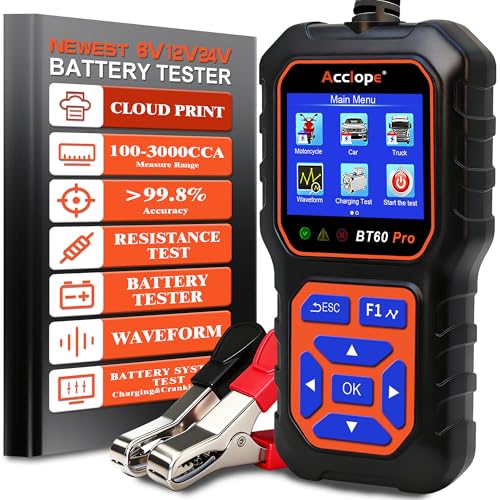
Heavy-duty trucks often run 24V electrical systems, and the BT60 PRO builds a dedicated mode specifically for that use case alongside standard 12V and 6V testing. It covers a wide 100-3000 CCA range, which comfortably handles larger truck batteries that smaller testers weren’t designed for, and adds QR code cloud printing so you can pull up a shareable result on your phone without a dedicated app or printer. Cold and hot cranking test modes specifically address the extreme conditions truck batteries often face.
| Pros | Cons |
|---|---|
| Dedicated 24V truck testing mode | Lithium battery CCA readings aren’t guaranteed accurate |
| Wide 100-3000 CCA range covers larger batteries | Not a carbon-pile load tester, conductance-based only |
| QR cloud printing needs no dedicated app | Powered by the test clamps, no standalone battery |
3. Schumacher BT-100 — Best Heavy-Duty/Traditional

If you prefer a traditional fixed-load tester over a digital conductance meter, the Schumacher BT-100 applies a real 100-amp load on a 12V battery (or 50 amps on 6V) to show how the battery performs under stress. That direct-load approach remains a common shop method alongside faster conductance testing. The steel case with baked enamel finish and heavy-duty clamps for both top- and side-terminal batteries are built to survive years of shop or garage use, not just a season or two.
| Pros | Cons |
|---|---|
| Genuine load testing under real amperage draw | No digital display or printed reports |
| Durable steel construction built to last for years | Heavier and bulkier than digital testers |
| Works on both top- and side-terminal batteries | Housing can become hot during a load test; follow the specified test duration and cooldown instructions |
4. KONNWEI KW208 — Best Budget Pick

The KW208 claims 99.7% test accuracy thanks to its updated galvanized alloy clips, and it covers the full range of common tests — voltage, internal resistance, CCA, AH capacity, plus cranking, charging, and alternator/starter checks — at a genuinely low price. It’s a clamp-powered plug-and-play design: connect the clips and it powers from the battery under test, provided the battery still has enough voltage for the tester to operate. That makes setup simple, but a completely flat battery may need to be charged or otherwise evaluated first.
| Pros | Cons |
|---|---|
| Very strong feature set for the price | No 24V support for heavy-duty truck systems |
| Clamp-powered; no separate tester battery required | Not rated for extreme temperature conditions |
| Compact enough to store in a glove box or toolbox | Basic build quality compared to premium testers |
5. Battery Tender Load Tester — Best Simple Load Tester
For a straightforward answer without menus or digital displays to navigate, this Battery Tender unit applies a real 100-amp load to a 12V battery (or 50-amp to 6V) and gives you a clear, color-coded readout. It’s built for starter and deep-cycle batteries alike across cars, pickup trucks, RVs, and boats, and the rubber-insulated handle plus color-coded alligator clamps keep the whole experience simple enough that anyone can use it without a learning curve.
| Pros | Cons |
|---|---|
| Dead simple operation with a single toggle switch | No CCA, SOH, or detailed digital readouts |
| Works on both starter and deep-cycle batteries | No 24V support |
| From a well-known, trusted battery-care brand | Manual load testing takes more hands-on attention |
Things to Consider Before You Buy
If you’re working on a heavy-duty or commercial truck, confirm whether its electrical system is 12V or 24V before buying — a tester without 24V support simply won’t work correctly on those systems, and this is one of the most common mismatches truck owners run into. Also make sure the CCA range covers your battery’s rating; larger truck batteries commonly exceed 1000 CCA, and a tester maxed out at 2000 CCA is fine for most, but confirm against your specific battery’s label if you’re running something unusually large.
Digital conductance testers are faster and more convenient for routine checks, while traditional load testers like the Schumacher BT-100 apply an actual amperage draw that some technicians consider a more definitive real-world test. Neither approach is wrong — pick based on whether you value speed and digital record-keeping or a more traditional hands-on testing method.
Related Guides
- How to test a car battery with a multimeter
- Battery voltage tester guide
- Best multimeters for automotive use
- How to test a battery with a multimeter
FAQ
Do I need a 24V tester for my truck?
Only if your truck actually runs a 24V electrical system, which is more common in heavy-duty and commercial trucks rather than standard consumer pickups. Check your owner’s manual or battery label to confirm before buying a tester without 24V support.
Why does my truck battery test differently in winter vs. summer?
Battery performance naturally drops in cold temperatures, which is why cold cranking amps (CCA) is the standard rating used for starting-power comparisons. A tester rated for a wide temperature range, like the TOPDON BT200, gives more consistent results across seasons.
Is a load tester or a digital conductance tester more accurate?
Both are considered valid, industry-accepted testing methods. Load testers apply a real amperage draw and are a long-trusted traditional approach, while digital conductance testers are faster and often add extra diagnostics like alternator output, without physically stressing the battery during the test.
Prices and availability shown above are pulled live from Amazon and can change at any time. Always confirm the current price and specs on the product page before purchasing.