
A battery tester with a built-in printer turns a quick diagnostic check into a documented record you can hand to a customer, attach to a work order, or keep for your own maintenance history. That paper trail matters more than it might seem — it’s proof of a battery’s condition at a specific point in time, which is useful whether you’re running a shop, managing a fleet, or just want documentation before approving a repair. We compared the best printer-equipped battery testers across price points and feature sets.
All prices below come live from Amazon through our product widgets, so you’re always seeing today’s listing rather than a static number.
As an Amazon Associate, Power Tools Today earns from qualifying purchases. Prices and availability are accurate as of the date shown and are subject to change.
Quick Picks
- Best Overall: TOPDON BT300P — 99.5% accuracy, ribbon-free thermal printing
- Best Budget Pick: OBDMONSTER BM550U — full diagnostic printing at a budget-friendly price
- Best for Cloud Sharing: KONNWEI KW700 — QR code cloud printing alongside paper reports
- Best Premium/Professional: FOXWELL BT780 — built-in battery power, multi-user profiles
- Best for Leakage + Load Testing: AUTOOL BT880 — adds dedicated leakage test to the standard suite
Quick Comparison: Key Specs
| Model | Voltage Support | Screen | Best For |
|---|---|---|---|
| TOPDON BT300P | 12V/24V | 2.4″ color | Fast, accurate all-rounder |
| OBDMONSTER BM550U | 6V/12V/24V | 1.8″ color | Tightest budget |
| KONNWEI KW700 | 12V/24V | 2.8″ color LCD | Digital record sharing via QR |
| FOXWELL BT780 | 12V/24V | 3.2″ LCD | Shops with multiple technicians |
| AUTOOL BT880 | 12V/24V | Color display | Adds current leakage testing |
Specs above are manufacturer-published ratings for reference. Pricing in the product boxes below is live and may differ from the table at the time you’re reading this.
1. TOPDON BT300P — Best Overall

The BT300P identifies the exact reason a battery failed in about 3 seconds, with TOPDON claiming 99.5% test accuracy — a genuinely useful number to see backed up on paper when you’re trying to convince yourself (or a customer) that a battery actually needs replacing. The built-in thermal printer needs no ribbons or cartridges, just standard thermal paper, which keeps ongoing costs low and means you’re never caught without ink mid-shift. Spark-free copper clamps and a long 31.5″ cable round out a well-built package for the price.
| Pros | Cons |
|---|---|
| Ribbon-free thermal printing keeps running costs low | 2.4″ screen is smaller than pricier competitors |
| Results in about 3 seconds with claimed 99.5% accuracy | No cloud/app connectivity |
| Long 31.5″ cable for easier positioning | Single-user, no technician profile management |
2. OBDMONSTER BM550U — Best Budget Pick

At a budget-friendly price, the BM550U still delivers a genuinely complete diagnostic report — internal resistance, voltage, SOH, SOC, and CCA — printed on standard thermal paper with two rolls included in the box. It covers 6V, 12V, and 24V batteries across common chemistries, and adds a real-time waveform monitoring function that lets you watch output changes as they happen, a feature that’s often missing at this price point entirely.
| Pros | Cons |
|---|---|
| Full diagnostic + printing suite at a budget price | Small 1.8″ screen |
| Real-time waveform monitoring is rare at this price | No lithium battery support |
| Includes two rolls of thermal paper | Less refined build than premium options |
3. KONNWEI KW700 — Best for Cloud Sharing

Beyond standard thermal printing, the KW700 adds QR code-enabled cloud printing — after a test, scan the code and pull up results on a smartphone browser with no app required. That’s a genuinely convenient way to share results with a customer or client without handing over a paper slip they’ll lose in the glovebox. It also supports custom-printed reports with shop names, VIN codes, and technician IDs, which is useful if you’re running a small operation and want traceable records.
| Pros | Cons |
|---|---|
| QR code cloud sharing skips paper loss risk | Requires a smartphone for the cloud feature to be useful |
| Customizable report branding for shop use | Mid-pack accuracy compared to premium testers |
| Supports lithium batteries in addition to lead-acid | 2.8″ screen is functional but not class-leading |
4. FOXWELL BT780 — Best Premium/Professional

The BT780’s standout feature is its built-in battery power — unlike testers that draw power from the battery under test, this one can power on independently, print saved reports, and review records anywhere without being connected. That also means more stable diagnostics on weak or discharged batteries, since the tester isn’t competing for power with the thing it’s trying to measure. Support for up to 4 user profiles with customizable shop and technician details makes it a strong fit for a multi-tech shop that needs traceable records across different jobs.
| Pros | Cons |
|---|---|
| Built-in battery works independent of the tested battery | Highest price point in this roundup |
| 4 user profiles support multi-technician shops | Doesn’t support deep cycle batteries |
| Includes 3 rolls of thermal paper and hard case | More features than a casual DIY user needs |
5. AUTOOL BT880 — Best for Leakage + Load Testing
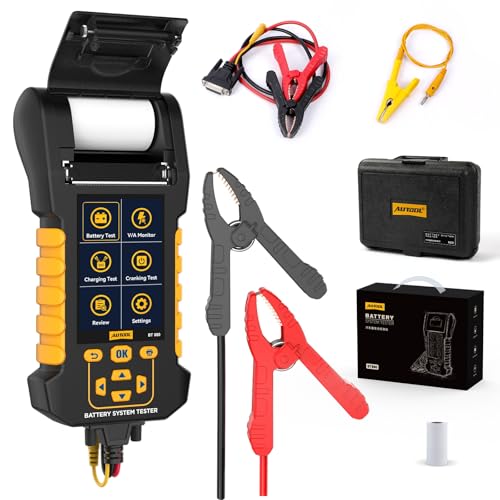
Most battery testers focus on voltage, CCA, and charging system checks, but the BT880 adds a dedicated current leakage test to the standard suite — useful for tracking down a mystery parasitic drain that’s killing a battery overnight. It also supports data review with waveform playback for up to 10 past tests, and the built-in printer lets you attach an SN number directly to a printed report, which is a nice touch for keeping work orders organized.
| Pros | Cons |
|---|---|
| Dedicated leakage test finds parasitic drains | Mid-range price sits between budget and premium options |
| Waveform playback for up to 10 past tests | USB firmware updates are Windows-only |
| 3-year warranty with lifetime technical support | Interface has more menus to learn than simpler testers |
Things to Consider Before You Buy
Think about how you’ll actually use the printed reports. If you’re running a shop and need traceable, customer-facing documentation, prioritize a tester with customizable report fields (shop name, technician ID, VIN) like the KONNWEI KW700 or FOXWELL BT780. If you just want a personal paper record for your own reference, a simpler and cheaper printer-equipped tester like the OBDMONSTER BM550U covers the basics without paying for features you won’t use.
Also check ongoing supply costs. Every tester here uses standard thermal paper rather than ink or ribbon cartridges, which keeps per-print costs low, but paper width and roll size can vary between brands — confirm you can easily source replacement rolls before committing to a specific model, especially if you’ll be printing reports frequently.
Related Guides
- How to test a car battery with a multimeter
- Battery voltage tester guide
- Best multimeters for automotive use
- How to test a battery with a multimeter
FAQ
Do I need special paper for these thermal printers?
Most use standard thermal paper similar to what’s used in retail receipt printers. Several of the testers here include a couple of starter rolls, and replacement rolls are widely available at office supply stores or on Amazon.
Is a printed report actually useful for a personal car, or just for shops?
It’s useful either way — a printed report gives you a dated record of your battery’s condition that you can compare against a later test, or bring to a repair shop as evidence before agreeing to a battery replacement.
Can these testers work without being connected to the battery, for reviewing old results?
Most models need to draw power from the connected battery to operate. The FOXWELL BT780 is a notable exception, with its own built-in battery that lets you power on and review or print saved results independently.
Prices and availability shown above are pulled live from Amazon and can change at any time. Always confirm the current price and specs on the product page before purchasing.