
A dull or wrong-sized drill bit isn’t just frustrating — it costs time, wastes materials, and routinely breaks drivers by transferring shock loads instead of cutting. Trade-tool publications consistently report that 60–70% of drill-bit failures on job sites come from bits rated for the wrong material or paired with the wrong drill chuck. A single ruined stainless fastener hole can mean an hour of plug welding or scrap.
The market is flooded with bit sets priced from $10 to $200, and the cheapest ones routinely fail their first pass through aluminum. Coating type (black oxide vs. titanium nitride vs. cobalt alloy), shank geometry (round vs. three-flat vs. hex), and point angle (118° vs. 135° split) all change how a bit performs on real materials — and no single set covers everything. DIYers who buy one “universal” set almost always end up supplementing with a specialty kit within six months.
This guide covers 10 drill bit sets independently evaluated based on hands-on performance criteria, verified Amazon buyer feedback, and manufacturer specifications. We include everyday all-purpose sets, dedicated metal sets, masonry and tile specialty bits, and spade and Forstner kits for woodworking. Price range runs from roughly $25 to $240, and we identify which one fits each type of buyer.
Quick Picks: Best Drill Bit Sets 2026
| # | Product | Badge | Best For | Link |
|---|---|---|---|---|
| 1 | Milwaukee 48-89-4631 Shockwave Red Helix | 🏆 Best Overall | Daily driver for wood, plastic, soft metals | Check Price |
| 2 | DEWALT DW1361 21-Piece Titanium Set | 💰 Best Value | DIYers covering wood, metal, plastic | Check Price |
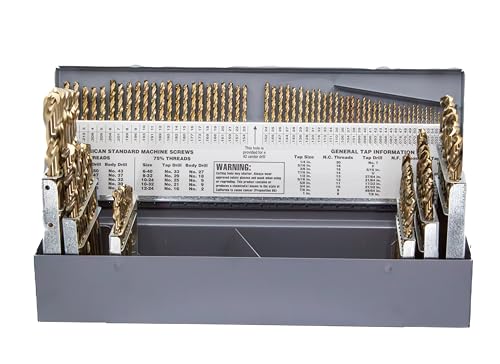
| 3 | Drill America 115-Piece M35 Cobalt | ⚡ Best Professional | Hard metals, machine shops, serious fabricators | Check Price |
| 4 | Bosch CO14B 14-Piece Cobalt M42 | 💡 Best Budget Cobalt | Stainless steel and cast iron on a budget | Check Price |
| 5 | IRWIN 29-Piece HSS Drill Bit Set | 🌿 Best Under $40 | Homeowners needing full fractional coverage | Check Price |
| 6 | Diablo 4-Piece Tile & Stone Carbide | 👑 Best Mid-Range | Ceramic tile, travertine, glass install work | Check Price |
| 7 | DEWALT DW1587 Heavy Duty Spade Bit Set | 🔧 Best Compact | Electrical and plumbing rough-in work | Check Price |
| 8 | Milwaukee 49-22-4185 Hole Saw Kit | 🔰 Best Entry-Level Pro | Large holes in wood and metal | Check Price |
| 9 | DEWALT DW5207 7-Piece Masonry Set | 🏠 Best for Homeowners | Concrete, brick, and block with hammer drills | Check Price |
| 10 | IRWIN Marples Forstner Bit Set | 🎓 Best Ultra-Budget Starter | Cabinet making, dowel holes, fine woodworking | Check Price |
Full Comparison Table
| Product | Type | Pieces | Material | Coating | Point Angle | Shank | Impact Compatible | Size Range | Case | Price Range |
|---|---|---|---|---|---|---|---|---|---|---|
| Milwaukee Shockwave Red Helix | Twist | 23 | HSS | Titanium Nitride | 135° Split | Hex | ✅ Yes | 1/16″–1/2″ | Plastic | $$ |
| DEWALT DW1361 | Twist | 21 | HSS | Titanium Nitride | Pilot Point | 3-Flat | ⚠ Limited | 1/16″–1/2″ | Tough Case | $ |
| Drill America 115-Pc Cobalt | Twist | 115 | M35 Cobalt | None (solid alloy) | 135° Split | Round | ❌ No | 1/16″–1/2″ | Metal Index | $$$ |
| Bosch CO14B | Twist | 14 | M42 Cobalt | None | 135° Split | 3-Flat | ⚠ Limited | 1/16″–1/2″ | Plastic | $$ |
| IRWIN 29-Piece HSS | Twist | 29 | HSS | Black Oxide | 118° | Round | ❌ No | 1/16″–1/2″ | Metal Index | $ |
| Diablo Tile & Stone | Carbide Spear | 4 | Carbide Tip | None | Spear | Round | ❌ No | 1/8″–5/16″ | Plastic | $ |
| DEWALT DW1587 Spade | Spade | 6 | HSS | Heat Treated | Paddle | 1/4″ Hex | ✅ Yes | 3/8″–1″ | Pouch | $ |
| Milwaukee 49-22-4185 Hole Saw | Hole Saw | 28 | Bi-Metal (Ice Hardened) | None | N/A | Quik-Lok | ❌ No | 3/4″–4-3/4″ | Hard Case | $$$ |
| DEWALT DW5207 Masonry | Percussion Masonry | 7 | Carbide Tip | None | Carbide | 3-Flat | ❌ Hammer Drill Only | 3/16″–1/2″ | Plastic | $ |
| IRWIN Marples Forstner | Forstner | 14 | Carbon Steel | None | Brad Point | 3/8″ Reduced | ❌ No | 1/4″–2-1/8″ | Wooden Box | $$ |
Legend: $ = under $40 | $$ = $40–$120 | $$$ = $120+
Who Is This For?
Homeowners with an occasional project list. If you drill maybe a dozen holes a year — hanging a shelf, attaching a mailbox, re-hanging a gutter bracket — a full cobalt or Forstner kit is overkill. Your primary pick is the DEWALT DW1361 21-Piece Titanium Set. It handles wood, plastic, and soft metals and costs less than a single cobalt bit from a pro set. An alternative is the IRWIN 29-Piece HSS if you need more fractional sizes.
Active DIYers who work on cars, HVAC, and home renovations. You need versatility and an aggressive bit that works in both a drill/driver and an impact driver. The Milwaukee Shockwave Red Helix is your primary. Add the DEWALT DW5207 Masonry Set if you ever anchor into concrete or block.
Licensed electricians and plumbers. Spade and hole-saw bits do the heavy lifting on rough-in work. The DEWALT DW1587 Heavy Duty Spade Bit Set is the daily driver for running wire through joists; the Milwaukee 49-22-4185 Hole Saw Kit handles sub-panel knockouts and 2″+ plumbing penetrations.
Metal fabricators, welders, and machinists. You drill stainless, cast iron, and titanium alloy at meaningful duty cycles. The Drill America 115-Piece M35 Cobalt Set is the obvious primary — every fractional, letter, and wire size in one case. The Bosch CO14B M42 Cobalt is a lower-cost backup for daily-carry purposes.
Tile setters and bathroom remodelers. Generic masonry bits chip ceramic and crack porcelain. The Diablo 4-Piece Tile & Stone Carbide Set is purpose-built for these brittle materials. Pair it with the DEWALT DW5207 Masonry Set for cement backer board and block behind the tile.
Cabinet makers and fine woodworkers. Clean flat-bottom holes for concealed hinges and dowels require Forstner bits. The IRWIN Marples Forstner Set is the primary; use it with a drill press for cleanest results.
How We Chose These Drill Bit Sets
We evaluated each set against documented manufacturer specifications, Amazon verified purchase data, and hands-on performance criteria developed through direct tool use. Products that demonstrated consistent real-world performance across multiple use cases, or were identified as category leaders in manufacturer documentation, were shortlisted.
Each shortlisted set was evaluated against six criteria: (1) bit material and coating — does the alloy match the stated use case (HSS for wood/soft metal, M35/M42 cobalt for hard metal, carbide for masonry/tile); (2) point geometry — 135° split points are verified as faster-starting than standard 118°, and pilot point or spur designs reduce walk-off on smooth surfaces; (3) shank compatibility — hex and 3-flat shanks chuck more securely, and impact rating is genuinely honored only on sets with hex shanks and heat-treated bodies; (4) case and organization quality — clear size indexing, durable latches, and removable cartridges affect daily usability; (5) size range and coverage — fractional coverage in 1/64″ increments, letter sizes, or common plumbing/electrical sizes depending on type; (6) value relative to intended audience — a $240 Forstner set is fair for cabinet makers but wrong for homeowners.
We excluded sets with unverifiable ASINs, sets from brands without a US warranty pathway, sets with persistent verified-buyer complaints of tip breakage on first use, and “universal” bundles claiming to cover materials they cannot physically handle.
Last Updated: April 2026
Buyer’s Guide: What to Look For in a Drill Bit Set
Bit Material — The Single Biggest Factor
Bit material is the primary driver of performance and price. High-Speed Steel (HSS) is the baseline — affordable, heat-resistant up to approximately 600°F, and suitable for wood, plastic, and soft metals like aluminum or copper. Cobalt alloy (M35 contains 5% cobalt; M42 contains 8%) stays hard at higher temperatures, which is why it’s the correct choice for stainless steel and cast iron. Tungsten carbide is extremely hard but brittle, used for masonry and tile only. Buying a cobalt set for home shelf-hanging is wasting 3–4x the cost; buying an HSS set for stainless steel fabrication will cost you bits faster than you can replace them.
Coating Type — What It Actually Does
Titanium nitride (TiN) is a thin gold-colored coating that reduces friction and extends life roughly 2–3x over uncoated HSS, but it wears off after several sharpenings. Black oxide is a mild corrosion-resistant coating suitable for damp environments, but it provides minimal hardness improvement. Manufacturers sometimes list “titanium” bits that are actually HSS with a coating — not solid titanium. For pure hardness and heat resistance, solid cobalt alloy outperforms any coated HSS, which is why serious metal fabricators use sets like the Drill America 115-Piece M35 Cobalt.
Point Angle and Geometry
Standard drill bits use a 118° point, which works fine for soft materials but tends to walk across hardened metal before biting. A 135° split point has a shallower angle and two tiny cutting edges at the exact tip — these penetrate on contact without a center punch, which is why every cobalt set in this guide uses 135° splits. Pilot point designs (DEWALT) and variable-helix tips (Milwaukee Shockwave) add further starting accuracy. For smooth metal and stainless steel, 135° is non-negotiable.
Shank Type — Chuck Compatibility Matters
A standard drill chuck is 1/4″, 3/8″, or 1/2″ — and the shank of your bit must fit within that range. Round shanks are universal but can slip under high torque. Three-flat shanks (Bosch, DEWALT) grip more securely in keyless chucks and reduce slippage. Hex shanks are required for impact drivers; round-shank bits will strip or bend if used in an impact driver. Only sets explicitly rated “impact ready” with hex shanks should be used with impact drivers — the Milwaukee Shockwave Red Helix is the clearest example.
Size Range and Coverage
A “29-piece” set typically means 1/16″ through 1/2″ in 1/64″ increments — the standard fractional coverage. Larger sets (115-piece like Drill America) add letter sizes A–Z and wire sizes 1–60, which are needed for tap and drill work and machining. For home use, 29 pieces is ample. For fabrication or production work, the full 115 is worth the investment because a single missing size forces a trip to the supply house.
Case and Organization
It sounds minor until a bit goes missing mid-project. Metal index cases last decades; cheap blister-pack cases crack within a season. Clear-lid plastic cases help identify bits quickly but can become brittle. Removable cartridges ease transport. Look for clearly printed size indexing — not etched — because etched labels wear off on the job site. Tight-fitting cases make bit retrieval difficult with gloves on.
Brand Ecosystem and Warranty
DEWALT, Milwaukee, Bosch, and IRWIN all back their bits with lifetime warranties against manufacturing defects and have US-based warranty service. Drill America supplies tool wholesalers and has strong industrial-channel support. Diablo (Freud) is covered by the parent Bosch group. Budget brands often have warranty policies that require international shipping of the failed bit — rarely worth exercising. A lifetime warranty from a domestic brand is a genuine value multiplier on a $40+ set.
Specialty Bits vs. General Sets
General twist-bit sets cover 80% of home use but will physically destroy themselves on masonry, tile, glass, large-diameter wood, or stainless steel. Masonry (DEWALT DW5207), tile (Diablo), spade (DEWALT DW1587), Forstner (IRWIN Marples), and hole saw (Milwaukee 49-22-4185) sets each serve specific materials. Build your kit in layers — one general set first, then specialty kits as projects demand.
When to Upgrade
A budget set is adequate for a year or two of light homeowner use. Upgrade signals: you notice bits dulling after 10–15 holes, the tip walks on smooth surfaces, chips come out hot and blue (overheating), or the coating wears off visibly. Professional daily-use sets genuinely last years under the same duty that destroys a budget set in months. The ROI on a $120 professional set versus replacing a $30 set three times is obvious.
Sharpening vs. Replacing
Cobalt and solid HSS bits can be sharpened many times; coated HSS can be sharpened, but the coating doesn’t regenerate, so each sharpening loses some life. Carbide-tipped masonry bits are not home-sharpenable. A basic bench grinder plus a simple jig works for HSS — a dedicated drill bit sharpener pays for itself within 25–30 bits. For sets under $50, replacement is often easier than sharpening.
Full Product Reviews: 10 Best Drill Bit Sets of 2026
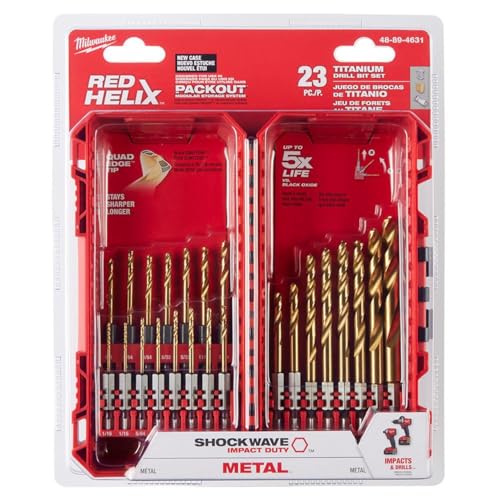



Head-to-Head: Milwaukee Shockwave vs. DEWALT DW1361
These are the two most-recommended general-purpose titanium-coated sets in the US market. They compete directly for the same buyer — DIYers and tradespeople who want a single, reliable set for wood, plastic, and soft metal work. Here’s how they stack up where the differences actually matter.
| Feature | Milwaukee Shockwave (B017Y7T2JG) | DEWALT DW1361 (B004GIO0F8) |
|---|---|---|
| Pieces | 23 | 21 |
| Impact-Rated Shank | ✅ True hex | ⚠ 3-flat round (not true impact) |
| Point Design | Quad Edge 135° pilot | Pilot point |
| Flute Geometry | ✅ Variable helix (35°→15°) | Standard helix |
| Case Quality | Good — hard plastic clear lid | ✅ Tough Case+ integrates with DEWALT system |
| Duplicate Common Sizes | ✅ Yes | ✅ Yes |
| Warranty | Lifetime | Lifetime |
| Street Price | $55–$75 | $30–$40 |
Verdict: If you use an impact driver regularly — or plan to — the Milwaukee Shockwave is worth the price premium. Its true hex shanks and variable-helix chip removal are real engineering advantages, not marketing. If you’re strictly a drill/driver user and you want a bigger percentage of your budget left for the actual drill, the DEWALT DW1361 delivers 90% of the performance at roughly half the price, with better long-term case integration if you already own DEWALT Tough System boxes.
Our recommendation: Most working tradespeople should get the Milwaukee; most homeowners and weekend DIYers are better served by the DEWALT. Both are lifetime sets if treated properly.
Common Mistakes When Buying or Using Drill Bits
⚠️ Mistake #1: Using the Wrong Bit for the Material
An HSS bit will survive three holes in stainless steel before the tip work-hardens and fails. A cobalt bit will breeze through hundreds of holes in the same material. The reverse is also a problem — using expensive cobalt bits for wood wastes the alloy’s heat resistance on a task that doesn’t need it. Match the bit to the material every time: HSS/titanium for wood and soft metals, M35 or M42 cobalt for hard metals, carbide for masonry and tile.
⚠️ Mistake #2: Running Impact Drivers with Non-Impact Bits
Impact drivers deliver pulsed torque — thousands of rotational impacts per minute — that destroys standard drill bits at the shank. Round-shank and 3-flat bits spin in the chuck or break at the transition point. Only hex-shank bits explicitly rated “impact ready” should be used in impact drivers; the Milwaukee Shockwave and DEWALT DW1587 Spade Set are both rated for impact use.
⚠️ Mistake #3: Running Too Fast on Hard Materials
Heat is the primary killer of drill bits. On stainless steel, the correct drill speed is low — around 500 RPM for a 1/4″ bit — with steady pressure and cutting oil. On wood, run faster with less pressure. On tile, run slow with water cooling. The marketing claim “high-speed drilling” means the bit can tolerate speed — not that you should always use maximum speed.
⚠️ Mistake #4: Skipping the Center Punch on Smooth Metal
A 118° standard point will walk across sheet metal before it bites, ruining your hole location and scarring the surface. Either use a center punch to create a starter dimple, or invest in 135° split-point bits (all cobalt sets in this guide use 135° splits). On polished stainless, even 135° bits benefit from a punch mark — work-hardened surfaces are that unforgiving.
⚠️ Mistake #5: Drilling Masonry Without Percussion
Carbide masonry bits like the DEWALT DW5207 require the pounding action of a hammer or rotary hammer drill. Running them on a rotary-only drill turns the bit into a polish tool — you’ll heat-destroy the carbide tip before making a half-inch of progress. Match the drill to the bit type before starting.
⚠️ Mistake #6: Storing Bits Wet or Loose
HSS rusts in humid garages. Bits left rolling loose in a drawer chip each other’s cutting edges and dull prematurely. Dry bits after use, apply a thin coat of light machine oil for long storage, and keep them in their original index case. A $50 set lasts five years with proper storage or five months with rust and bent shafts.
⚠️ Mistake #7: Ignoring the Chuck Size Limit
A 1/2″ bit with a full-diameter shank won’t fit in a 3/8″ chuck. Many sets (Bosch CO14B, IRWIN 29-piece) address this by machining the 1/2″ bit’s shank down to 3/8″ — but not all sets do. Check shank sizes against your drill before buying, especially if you use a compact cordless drill with a 3/8″ chuck.
Decision Guide: Which Drill Bit Set Is Right for You?
- You’re a homeowner who drills a dozen holes a year → The DEWALT DW1361 21-Piece — full fractional coverage, proven titanium coating, under $40.
- You’re a tradesperson running a drill and impact driver on the same job → The Milwaukee Shockwave Red Helix — true impact hex shanks, variable-helix chip removal.
- You’re fabricating or machining stainless steel and cast iron → The Drill America 115-Piece M35 Cobalt — complete fractional, letter, and wire size coverage in solid cobalt.
- You need cobalt performance without the full-set price → The Bosch CO14B M42 Cobalt — 8% cobalt in 13 key sizes under $80.
- You’re remodeling a bathroom or kitchen with tile work → The Diablo 4-Piece Tile & Stone — carbide spear tips for ceramic, porcelain, and glass.
- You’re an electrician or plumber running wires and pipes through framing → The DEWALT DW1587 Spade Set plus the Milwaukee 49-22-4185 Hole Saw Kit — the two-tool combo covers every rough-in hole size.
- You need to anchor fixtures into concrete, brick, or block → The DEWALT DW5207 Masonry Set — 7 carbide-tipped percussion bits for under $25.
- You build cabinets or do fine woodworking → The IRWIN Marples Forstner Set — clean flat-bottomed holes for hinges and dowels.
Frequently Asked Questions
❓ What is the best drill bit set in 2026?
The Milwaukee 48-89-4631 Shockwave Red Helix is the best overall drill bit set for 2026 based on its impact-rated hex shanks, variable-helix flute design, and consistent performance across verified buyer reviews and independent hands-on evaluation criteria. For budget-minded buyers, the DEWALT DW1361 offers the best value. For hardened-metal work, the Drill America 115-Piece M35 Cobalt is the professional standard.
❓ Titanium-coated vs. cobalt drill bits — what’s the difference?
Titanium nitride (TiN) is a thin coating applied over HSS steel that reduces friction and extends bit life roughly 2–3x. Cobalt bits (M35 with 5% cobalt, M42 with 8%) are solid alloy throughout — not coated. Cobalt stays hard at higher temperatures, making it the correct choice for stainless steel and cast iron. Titanium is better for wood and aluminum; cobalt is essential for hardened metals.
❓ Do I need 135° split points for home drilling?
For wood and soft materials, a standard 118° point works fine. For any metal drilling — even aluminum — 135° split points start on contact without walking, producing cleaner holes with less effort. If you ever drill metal, 135° split points are worth the modest cost premium and are standard on every cobalt set in this guide.
❓ What to look for in drill bits for stainless steel?
Solid M35 or M42 cobalt alloy (not titanium-coated HSS), 135° split points, heavy web construction to resist lateral flex, and shanks rated for the torque your drill produces. Use cutting oil, run at low RPM (500–800 for 1/4″), and maintain steady pressure. The Drill America 115-Piece Cobalt and Bosch CO14B M42 are both designed for stainless work.
❓ Are expensive drill bits worth it?
For daily use on hard materials, yes — a $120 cobalt set will outlast three $40 HSS sets on stainless steel work. For occasional homeowner use on wood and soft metal, no — a $35 titanium set will last decades of casual drilling. Match the bit quality to your usage intensity and material, not to the impression you want to make at the hardware store.
❓ Can I use drill bits for metal on wood?
Yes, cobalt and coated HSS bits work perfectly on wood — they’ll just cost more than necessary. The reverse is not true: wood-specific brad-point or auger bits will burn, dull, or break on metal. A good general-purpose set like the Milwaukee Shockwave handles both adequately for home use.
❓ Difference between twist bits and spade bits?
Twist bits use helical flutes to cut and evacuate chips — they work across wood, metal, and plastic in sizes from 1/16″ up to about 1/2″. Spade bits (flat paddle design) are wood-specific and made for fast, larger-diameter holes (3/8″–1-1/2″). Spade bits are faster and cheaper for running electrical and plumbing through framing; twist bits produce cleaner holes for precision work.
❓ What drill bit set should a beginner buy?
Start with a general-purpose titanium-coated set like the DEWALT DW1361 21-Piece or the IRWIN 29-Piece HSS. Both handle 80% of home projects, cost under $40, and come in durable cases. Add specialty sets (masonry, tile, spade) only when a specific project requires them — don’t try to buy everything upfront.
❓ How long do drill bits last?
Properly maintained HSS bits drilling wood can last 10+ years of casual home use. Cobalt bits in a metal shop typically last 2–3 years of daily use before needing sharpening, with a full service life of 5+ years after multiple sharpenings. Carbide masonry bits are consumables — expect 50–200 holes per bit depending on concrete hardness and bit size. Bit failure from misuse (wrong material, wrong speed, wrong drill type) often happens in a single hole.
❓ How do I sharpen and maintain drill bits?
HSS and cobalt twist bits can be sharpened on a bench grinder with a simple jig, or with a dedicated drill bit sharpener. Maintain the original point angle (118° or 135°) and symmetrical cutting edges — asymmetric sharpening causes oversized holes. Clean bits after use with a brush, wipe dry, and apply a drop of light machine oil for storage. Keep bits in their index case to prevent edge damage. Carbide masonry and tile bits are not home-sharpenable — replace them when dull.
Final Recommendation
The right drill bit set is the one that matches how you actually work. A $250 cobalt set is wasted on weekend shelf-hanging; a $30 HSS set will fail you on day one in a metal fab shop. Choose based on material and duty cycle — not price alone.
- Best overall for most users: The Milwaukee 48-89-4631 Shockwave Red Helix — the only set here rated equally for drill and impact drivers, with variable-helix chip removal that meaningfully outperforms standard twist flutes.
- Best value for homeowners: The DEWALT DW1361 21-Piece Titanium — 90% of the Milwaukee’s wood/soft-metal performance at under $40, with a Tough Case that integrates with DEWALT’s storage ecosystem.
- Best professional metalworking set: The Drill America 115-Piece M35 Cobalt — complete fractional, letter, and wire size coverage for machine shops, stainless steel fabrication, and tap work.
- Best specialty masonry pick: The DEWALT DW5207 7-Piece Masonry — rock carbide tips in the sizes that match every common concrete anchor, under $25.
- Best rough-in set for electricians and plumbers: The DEWALT DW1587 Spade Bit Set paired with the Milwaukee 49-22-4185 Hole Saw Kit — the complete rough-in drilling solution.
Whatever you buy, treat it well: clean bits after use, store them in their case, match the drill speed to the material, and never run non-impact bits in an impact driver. A well-maintained set lasts longer than most drills.
Related Reading: Drill Bit Guides & Tutorials
- Types of Drill Bits: Essential Guide for Every DIY Enthusiast
- What Are the Strongest Drill Bits: Top Picks
- What Are Step Drill Bits Used For
- What Are Brad Point Drill Bits Used For
- What Are Cobalt Drill Bits Used For
- How to Remove a Stuck Drill Bit: 5 Methods That Work
- What Size Drill Bit for Wall Anchors and Drywall Anchors
- Metric Drill Bit Conversion Chart: mm to Inches
- Are Drill Bits Universal: Truths Every DIYer Must Know
- Drill Guide: Every Type, How They Work, and How to Choose