
A dead or weak car battery can stop your day fast, but How to Test a 12V Battery With a Multimeter is simpler than most people think. With one small tool, you can check whether the battery is healthy, partly discharged, or failing.
You do not need advanced skills for this. You only need a multimeter, a few minutes, and the right order of steps. The method below shows you how to get a useful reading, what the numbers mean, and how to avoid common mistakes that give false results.
By the end, you will know how to test a 12V battery safely, read the voltage correctly, and decide whether the battery needs charging, further testing, or replacement.
What you need before you start
A multimeter is the main tool, but a few simple checks make the reading more reliable. A 12V battery can show a decent voltage at rest and still fail under load, so your test should begin with the battery and the meter in good condition.
For the best result, park the vehicle or place the battery on a stable surface, keep the area dry, and make sure the battery terminals are easy to reach. If the battery is in a car, turn the ignition off and remove all accessories like lights, fans, and chargers. Even small electrical loads can change the reading.
Tools and safety basics
- Digital multimeter with DC voltage setting
- Safety glasses if the battery is mounted in a vehicle
- Gloves if the terminals are corroded
- Clean cloth or brush for dirty terminals
- Optional: battery charger or load tester for follow-up testing
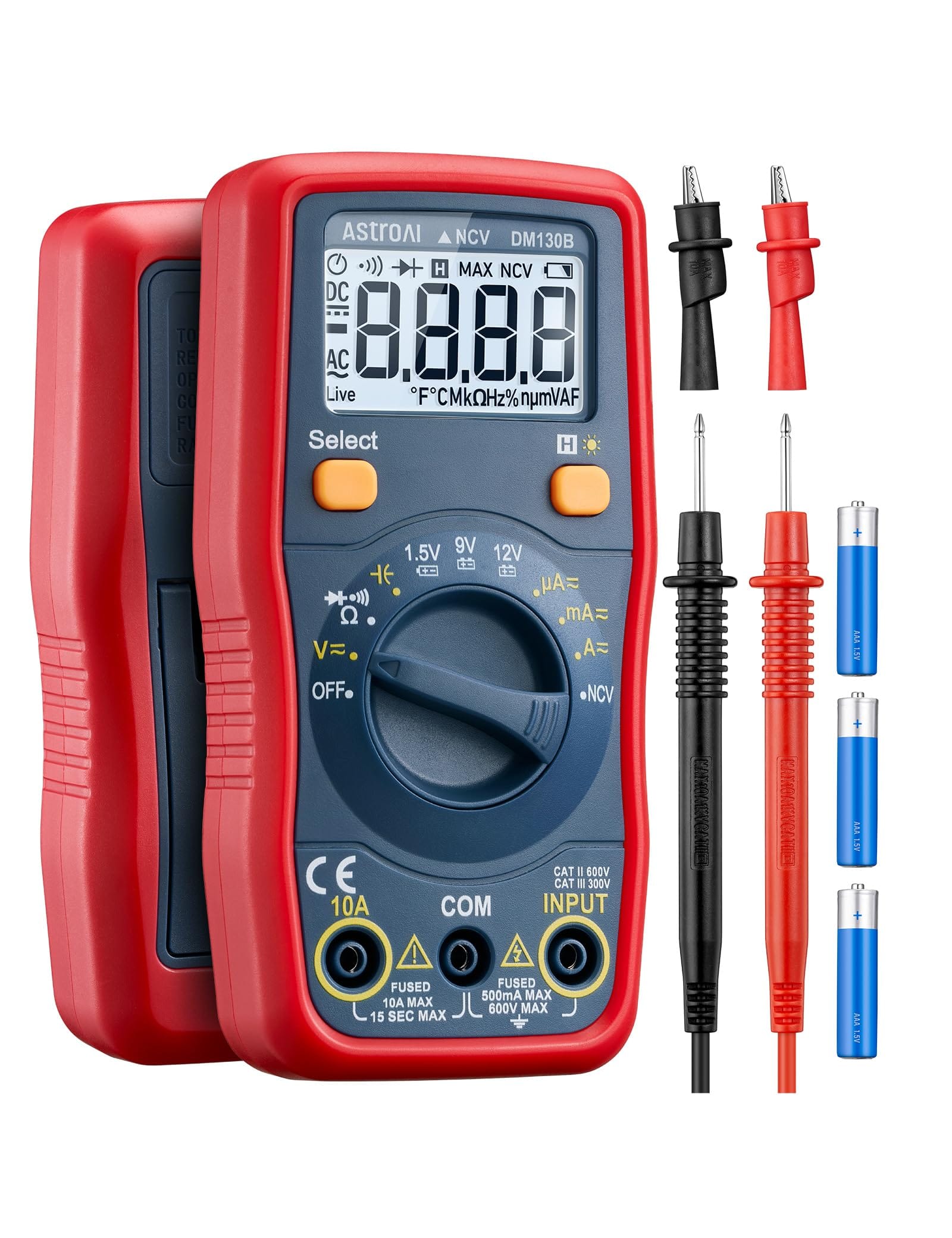
Use a digital meter if you can. It is easier to read and usually gives more stable numbers than an old analog meter. Most basic meters can measure 12V battery voltage without any special settings.
If you are working on a battery in a garage, keep sparks away. Lead-acid batteries can release hydrogen gas, which is flammable. For general battery safety, the official CPSC safety guidance is a good reference point for safe handling habits around household equipment and batteries.
Set the multimeter the right way
The most common mistake is using the wrong meter setting. A 12V battery produces direct current, so your meter must be set to DC voltage, not AC voltage. On many meters, DC is marked with a straight line and dotted line above it, or with the symbol V⎓.
Choose a range above 12 volts if your meter is not auto-ranging. A 20V DC setting is ideal for a standard 12V battery. That gives enough room to read fully charged batteries, which often sit around 12.6 to 12.8 volts when rested.
How to connect the probes
- Insert the black probe into the COM port.
- Insert the red probe into the voltage port, usually marked V.
- Touch the black probe to the battery’s negative terminal.
- Touch the red probe to the battery’s positive terminal.
If you reverse the probes, the meter usually shows a negative number. That does not mean the battery voltage changed. It only means the leads are backward.
Keep the probe tips steady on the terminal tops or the exposed metal posts. If you press too lightly, the number may jump around. If the terminals are dirty, clean them first. Corrosion can create weak contact and make a healthy battery look worse than it is.
Read the voltage and understand what it means
The voltage reading is the heart of How to Test a 12V Battery With a Multimeter. But the number only makes sense if you know when the battery was last used or charged. A battery that just came off a charger may read higher for a short time, while a battery that has been sitting overnight gives a more honest resting voltage.
For a basic test, let the battery rest for at least 30 minutes after charging or heavy use. If possible, wait several hours for the most accurate open-circuit reading. This resting voltage tells you the state of charge more clearly than a reading taken right after driving or charging.
The following voltage guide helps you interpret a typical 12V lead-acid battery at rest:
| Resting voltage | What it usually means |
|---|---|
| 12.6V to 12.8V | Fully charged or near full |
| 12.4V to 12.5V | Partly charged, but often still usable |
| 12.2V to 12.3V | Low charge; battery should be recharged soon |
| 12.0V to 12.1V | Very low charge |
| Below 12.0V | Battery is deeply discharged or possibly failing |
These numbers are useful, but they are not the whole story. A battery can show 12.6V and still be weak if one internal cell is damaged. That is why voltage is a good first test, not the final answer.
What “good” really looks like
For most 12V lead-acid batteries, a resting voltage around 12.6V is a healthy sign. Readings around 12.4V are not automatically bad, but they usually mean the battery is not fully charged. If the battery is below 12.2V after resting, charging is usually needed before you decide anything else.
One detail many beginners miss: surface charge can make a battery look better than it is. If the battery was just charged or the engine was just running, the voltage may sit a bit high for a while. That is why a rest period matters.
Test the battery while it is under load
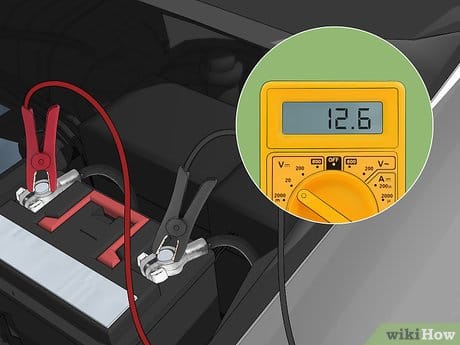
A resting voltage test tells you charge level, but not always battery strength. To find out whether the battery can actually deliver power, test it while a load is applied. In a car, that usually means watching the voltage while someone turns the key to start the engine. If you are testing a loose battery, a proper load tester gives a better result, but you can still learn a lot with a multimeter alone.
When the starter motor engages, battery voltage should drop, but not collapse. A healthy 12V battery often stays above 9.6V during cranking in moderate conditions. If it falls much lower, the battery may be weak, discharged, or failing under demand.
Credit: wikihow.com
How to do a simple cranking test
- Set the meter to DC voltage.
- Connect the probes to the battery terminals.
- Watch the screen while a helper starts the vehicle.
- Note the lowest voltage during cranking.
Cold weather matters here. Batteries lose cranking power when temperatures drop. A battery that struggles at 8°C may fail completely at -7°C. That is normal physics, not just bad luck.
If the voltage drops below 9.6V during cranking, the battery is suspect. If it drops very fast and the engine turns slowly, the battery may be weak. If the battery voltage stays decent but the engine still cranks slowly, the problem may be the starter, cables, or ground connection instead of the battery itself.
Why load testing gives more truth than voltage alone
This is the first non-obvious point many people miss: a battery can “look good” at rest and still fail the moment real current is needed. That is because internal resistance rises as batteries age. The battery may hold voltage when nothing is happening, then collapse under demand.
Another useful clue is recovery speed. After cranking, a healthy battery usually rebounds quickly. If the voltage stays low or recovers very slowly, the battery may not be holding charge well.
If this 12V battery is installed in a car, see our car battery multimeter guide for automotive cranking and charging-system diagnosis.
Check the charging system if the battery seems weak
If the battery test shows low voltage, the battery may not be the real problem. A weak alternator or bad charging circuit can leave a good battery undercharged. That is why many repeated “dead battery” problems return after a jump start.
Start the engine, then measure battery voltage again with the engine idling. Most charging systems should raise voltage above resting battery voltage. A common healthy range is about 13.7V to 14.7V, though exact numbers can vary by vehicle and temperature.
What the charging reading tells you
- Below 13.2V: charging may be weak or absent
- 13.7V to 14.7V: usually normal charging range
- Above 15.0V: possible overcharging problem
If the charging voltage is too low, the battery may never fully recover. If it is too high, the battery can overheat, lose water faster, and wear out early. That is why a battery test and charging test should be done together when the problem keeps coming back.
For vehicle-specific guidance, check the official owner or service information for your model. Manufacturer charging specs are often more accurate than generic advice, especially on modern vehicles with smart alternators and battery management systems.
Common mistakes that give bad readings
Many weak-battery “diagnoses” are really testing mistakes. The good news is that most of them are easy to avoid once you know what to watch for.

Credit: himaxelectronics.com
1. Testing the wrong side of the battery
Always test directly on the battery posts or exposed terminals when possible. Testing on corroded cable ends can hide a bad connection. A battery may be fine, but a bad terminal can still stop the car from starting.
2. Leaving loads turned on
Headlights, cabin lights, radios, and chargers can pull the voltage down while you test. Turn everything off before taking a resting reading. Even a small drain can change the result enough to confuse the diagnosis.
3. Using AC mode instead of DC mode
Battery voltage is direct current. If the meter is on AC, the reading will be wrong or meaningless. This error is more common than people think, especially with beginner meters that have similar-looking symbols.
4. Testing right after charging or driving
A fresh charge creates a temporary surface voltage boost. The battery may look stronger than it truly is. Give it time to rest if you want a realistic reading.
5. Ignoring cable and terminal problems
This is the second non-obvious insight: a weak start is not always a weak battery. Corrosion, loose clamps, damaged cables, or a bad ground can mimic battery failure. If the battery tests fine but the car still struggles, inspect the connections closely.
What to do next based on the result
Once you have the reading, use it to guide the next step instead of guessing. A battery test is most useful when it leads to action.
- 12.6V to 12.8V at rest: the battery is likely charged. If the vehicle still has trouble starting, look at the starter, cables, and charging system.
- 12.4V to 12.5V: charge the battery and retest after it rests.
- 12.2V to 12.3V: the battery is low. Recharge it before making a final decision.
- Below 12.0V: deeply discharged or possibly failing. Recharge and test again, but be ready to replace it if it will not recover.
- Below 9.6V during cranking: the battery is likely weak under load, especially if the connections are clean and tight.
If the battery repeatedly drops below a normal resting voltage after being charged, it may have an internal problem. A failing battery can sometimes recover enough to start the vehicle once or twice, then fail again the next day. That pattern is a classic sign of aging cells.
For lead-acid batteries, age matters. Many last about 3 to 5 years, but heat, short trips, and deep discharges can shorten that life. A battery in a hot climate often dies sooner than one in mild weather.
When a multimeter is not enough
A multimeter gives a strong first check, but it cannot tell you everything. It measures voltage, not full battery capacity. That means it cannot fully predict how long the battery can power accessories, how well it handles cold starts, or whether one cell has begun to fail in a subtle way.
If the battery has trouble after a full charge, a professional load test or conductance test can give better detail. These tests measure how the battery behaves under demand, which is often more useful than resting voltage alone.
If you have a sealed AGM or start-stop battery, the test still works, but the expected numbers and failure patterns may differ slightly from a standard flooded battery. In those cases, follow the manufacturer’s guidance for your exact battery type.
Official vehicle and battery guidance from the manufacturer is the safest place to confirm charging specs, especially on newer vehicles. If your battery is tied to complex electronics, a simple voltage reading is only part of the picture.
A simple routine that saves time later
The easiest way to avoid surprise failures is to test the battery before winter, before a long trip, or any time the engine starts to sound slower than usual. A 12V battery usually gives warning signs before it dies completely.
Here is a practical routine that works well:
- Test resting voltage once the battery has been unused for a while.
- Test again while cranking if the vehicle starts slowly.
- Check charging voltage with the engine running.
- Inspect terminals and cables for corrosion or looseness.
This takes only a few minutes, but it can prevent a no-start problem on a cold morning. It can also save you from replacing a battery that was not actually the real problem.
If you want one rule to remember, make it this: resting voltage tells you charge, cranking voltage tells you strength, and charging voltage tells you whether the system is refilling the battery properly. Those three checks together give a clear picture.
Credit: amazon.com
Final takeaway
How to Test a 12V Battery With a Multimeter comes down to three things: set the meter to DC volts, read the resting voltage correctly, and check how the battery behaves under load. A good battery usually sits near 12.6V at rest and stays above about 9.6V during cranking, while the charging system should typically show around 13.7V to 14.7V with the engine running.
That simple process helps you separate a weak battery from bad cables, charging problems, or starter issues. Once you know which part is failing, you can fix the real problem instead of guessing.
If you want a broader refresher on reading the meter itself, see how to test DC voltage with a multimeter. And if the battery seems fine but the circuit still does not work, how to test a wire with a multimeter can help you check cables, grounds, and connections.
Safety note: Keep sparks, cigarettes, and open flames away from lead-acid batteries, and do not let metal tools bridge the terminals while testing.
FAQs
How do you test a 12V battery with a multimeter?
Set the multimeter to DC voltage, connect the black probe to the negative terminal and the red probe to the positive terminal, then read the voltage. A rested battery near 12.6V is usually healthy, while a reading below 12.2V means it is low and should be charged before further testing.
What voltage means a 12V battery is bad?
There is no single number that always means “bad,” but a battery below 12.0V at rest is deeply discharged or possibly failing. If it drops below about 9.6V while cranking, that is a strong sign the battery is weak under load.
Can a battery show 12.6V and still be bad?
Yes. A battery can hold a normal resting voltage and still fail when power is needed. That is why a cranking or load test matters. Internal damage may not appear until the battery has to deliver high current.
Should I test the battery before or after charging it?
For the most useful resting reading, test it after it has sat unused for a while. If the battery is low, charge it and then test again after it rests. This helps you see both the state of charge and whether the battery can hold that charge.
Why does my battery voltage drop when I try to start the car?
Some voltage drop is normal during cranking, but a large drop usually means the battery is weak, undercharged, or has high internal resistance. Dirty terminals, loose cables, or a bad starter can also cause the same symptom, so inspect the full starting system if the battery seems fine.
