
Cutting through a full inch of steel separates hobby-grade plasma cutters from machines that can actually handle heavy fabrication, trailer builds, and thick structural work. Not every “plasma cutter” on the market can cleanly sever 1″ mild steel — many top out around 1/2″ to 3/4″ before the cut quality falls apart or the duty cycle collapses. We focused this roundup on units that are rated for a true 1″ cut (or close to it) so you’re not stuck fighting slag and incomplete cuts on your next thick-plate project.
All prices and availability below are pulled live from Amazon, so what you see reflects the current listing rather than a number we typed in once and forgot about.
As an Amazon Associate, Power Tools Today earns from qualifying purchases. Prices and availability are accurate as of the date shown and are subject to change.
Quick Picks
- Best Overall for 1″ Steel: SILATU 75A Plasma Cutter — HF pilot arc, explicitly rated for 1″ max cut
- Best Heavy-Duty/Flagship: LOTOS Apex LTP8500 85A — 1″ clean cut, 1.5″ severance capacity
- Best Value: AZZUNO 65A Non-Touch Pilot Arc — budget-friendly, still rated to 1″
- Best for Thicker Bevel Cuts: ARCCAPTAIN 65A 3-in-1 — 1-3/16″ max cut, roller guide wheel
- Best Non-HF Option: ARCCAPTAIN 55A Blowback Start — no high-frequency interference, ~1″ max cut
Quick Comparison: Key Specs
| Model | Amperage | Max Cut | Arc Start | Best For |
|---|---|---|---|---|
| SILATU 75A | 75A | 1″ | HF Pilot Arc | Overall best fit for this job |
| LOTOS Apex LTP8500 | 85A | 1″ clean / 1.5″ sever | HF Pilot Arc | Heavy-duty/production work |
| AZZUNO 65A | 65A | 1″ | Non-Touch Pilot Arc | Budget-conscious shops |
| ARCCAPTAIN 65A 3-in-1 | 65A | 1-3/16″ | HF Pilot Arc | Thicker plate, bevel cuts |
| ARCCAPTAIN 55A Blowback | 55A | ~1″ (26mm) | Non-HF Blowback | Sensitive electronics nearby |
Specs above are manufacturer-published ratings for reference. Pricing in the product boxes below is live and may differ from the table at the time you’re reading this.
1. SILATU 75A Plasma Cutter — Best Overall for 1″ Steel

The SILATU 75A is built around a straightforward promise: cut a full inch of steel without babying the machine. Its high-frequency pilot arc fires reliably even on rusty or painted surfaces, which matters when you’re working with reclaimed structural steel rather than clean stock. At 75A it has enough headroom that you’re not maxing out the duty cycle every time you tackle a thick piece, and the torch consumables are common enough that you won’t be waiting on a specialty order mid-project.
| Pros | Cons |
|---|---|
| Genuinely rated to 1″ cut, not just marketing math | Needs a dedicated 220V circuit |
| HF start works well through mill scale and paint | HF start can interfere with nearby sensitive electronics |
| Strong price-to-capability ratio | Torch cable length is fairly short for larger shops |
2. LOTOS Apex LTP8500 85A — Best Heavy-Duty / Flagship Option

When 1″ clean cuts aren’t quite enough and you occasionally need to sever up to 1.5″, the LTP8500 is the machine that has margin to spare. LOTOS built this as their top-tier unit, and it shows in the drag-cut torch design that lets you rest the tip directly on the workpiece for straighter, more repeatable lines even on thick material. It’s the priciest pick here, but for anyone running a production shop or fabricating trailer frames and heavy equipment repairs regularly, the extra amperage and severance capacity pay for themselves in fewer failed passes.
| Pros | Cons |
|---|---|
| 1.5″ severance gives real margin above 1″ jobs | Highest price point in this roundup |
| Drag-cut torch improves line control on thick stock | Larger and heavier than hobby-class cutters |
| Backed by LOTOS’s established support network | Overkill if you rarely go past 1/2″ |
3. AZZUNO 65A Non-Touch Pilot Arc — Best Value
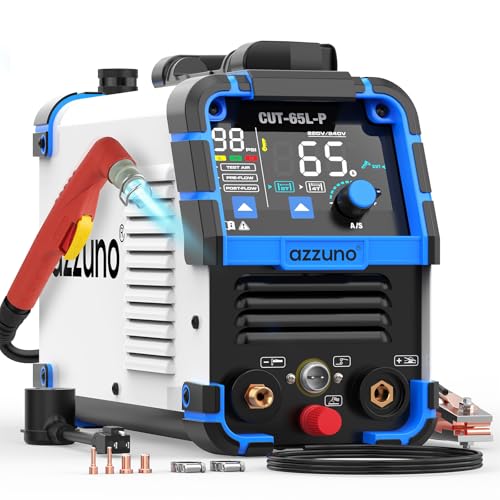
AZZUNO Plasma Cutter 65A, Non-Touch Pilot Arc, 110V/220V Max Cut 1"
AZZUNO’s 65A unit proves you don’t need flagship pricing to get a genuine 1″ rating. The non-touch pilot arc starts cleanly without dragging the tip through rust or scale, and the amperage is high enough to push through a full inch without stalling out partway through the cut. It won’t have the polish or duty-cycle headroom of the pricier machines here, but for a garage or small farm shop that occasionally needs to cut thick plate, it’s a sensible way to get there without overspending.
| Pros | Cons |
|---|---|
| Lowest price of any 1″-rated cutter in this list | Duty cycle drops faster on back-to-back thick cuts |
| Non-touch pilot arc starts cleanly on dirty steel | Consumables wear faster at the top of its rated capacity |
| Compact enough for a small home shop | Less headroom for future upgrades to thicker material |
4. ARCCAPTAIN 65A 3-in-1 — Best for Thicker Bevel Cuts

The ARCCAPTAIN 65A stands out here because it’s rated slightly past 1″ at 1-3/16″, giving you a genuine cushion for bevel cuts and pierce-heavy work where the effective cutting path is longer than a straight pass. The roller guide wheel is a nice touch for anyone cutting long, straight runs on plate steel — it keeps the torch height consistent without you having to eyeball it the whole way down the cut. Three selectable cutting modes also make it easier to dial in settings for different metal types without guessing.
| Pros | Cons |
|---|---|
| Rated past 1″, extra margin for bevels and pierces | Higher price than the AZZUNO or SILATU |
| Roller guide wheel improves long straight cuts | HF start requires the usual EMI precautions |
| Multiple cutting modes for different materials | Bulkier housing than the 55A/65A budget units |
5. ARCCAPTAIN 55A Blowback Start — Best Non-HF Option
If you’ve ever had a high-frequency start scramble a nearby computer, garage door opener, or shop electronics, you already understand the appeal of blowback-start plasma cutters. The ARCCAPTAIN 55A skips the HF circuitry entirely while still reaching roughly an inch of cutting capacity at 220V, making it a solid pick for shops that share space with sensitive equipment or that just want to avoid HF-related nuisance trips. It’s the lowest amperage cutter on this list, so it’s working closer to its ceiling at a full inch than the others — plan on slower travel speed for the thickest cuts.
| Pros | Cons |
|---|---|
| No HF interference with nearby electronics | Working near its ceiling at 1″, slower travel speed needed |
| Simpler blowback start is low-maintenance | Lowest amperage of the cutters featured here |
| Good fit for shared or electronics-sensitive shops | Less margin for repeated back-to-back thick cuts |
Things to Consider Before You Buy
A manufacturer’s “max cut” rating is usually a best-case number measured on clean, new steel at a slow travel speed — real-world results on rusty, painted, or coated material will run a bit thinner. If your work is consistently at or near 1″, it’s worth sizing up to a cutter rated slightly above your target thickness rather than one that just barely claims it. Amperage needs don’t scale in a simple straight line with thickness, either — as a reference point, Hypertherm’s published cut charts show roughly 45A handling clean cuts up to about 1/2″, while it takes closer to 85A to reach a genuine 1″ clean cut, and around 105A for 1-1/4″. The exact number for any given machine also depends on the material’s condition, gas/air quality, torch height, travel speed, and consumable wear, so treat any rule of thumb as a rough starting point and check the specific cutter’s own cut chart rather than assuming a flat amps-per-inch ratio. Also check your available power — most 1″-capable machines need a dedicated 220-240V circuit, not standard household 120V, so confirm your shop’s electrical setup before ordering.
Duty cycle is easy to overlook until you’re mid-project. A cutter might be rated for 1″ but only at a 20-30% duty cycle at max amperage, meaning it needs to cool down often if you’re making cut after cut. If you’re doing production work rather than occasional repairs, look closely at the duty cycle spec at your expected amperage, not just the headline max-cut number.
Related Guides
- Best plasma cutters
- How to use a plasma cutter
- How thick can a plasma cutter cut?
- What is a plasma cutter?
FAQ
What amperage do I need to cut 1″ steel?
Most manufacturers rate a genuine 1″ clean cut in mild steel in the 75-85A range, based on published cut charts from brands like Hypertherm — a 45A machine is typically good for around 1/2″, not a full inch. Cutters at 55A can often sever an inch but will be working near their limit with a slower cut and a rougher edge. Always check the specific machine’s own cut chart rather than a generic rule of thumb, since actual capacity depends on consumables, gas quality, and travel speed too.
Will these cutters actually give a clean edge at 1″?
Expect some dross and a rougher edge at maximum rated thickness on any plasma cutter — that’s normal. For the cleanest edges at 1″, look at the “clean cut” rating specifically rather than the “severance” rating, since severance just means the arc can get through the material, not that the edge will be smooth.
Is HF start a problem for 1″ cutting?
No — high-frequency start doesn’t affect cut quality or capacity, it only affects how the arc initiates. The main consideration is whether HF interference is an issue for other electronics nearby, which is where a blowback-start option like the ARCCAPTAIN 55A comes in.
Prices and availability shown above are pulled live from Amazon and can change at any time. Always confirm the current price and specs on the product page before purchasing.
