
The Fluke 1507 has become a default recommendation for electricians and industrial maintenance techs who need a dedicated megohmmeter rather than a multimeter with an insulation-testing mode bolted on. It’s not the cheapest way to check insulation resistance, but it’s built around a specific job — testing motors, cables, and transformer windings at up to 1000V — and does it with the kind of reliability that shows up on a lot of “what’s in your truck” lists. This review covers what the 1507 actually offers, how it compares to Fluke’s other insulation testers, and who should consider stepping up or down from it.
All pricing below is pulled live from Amazon through our product widgets, so what you see reflects the current listing rather than a number we wrote down once.
As an Amazon Associate, Power Tools Today earns from qualifying purchases. Prices and availability are accurate as of the date shown and are subject to change.
Quick Picks
- The Reviewed Unit: Fluke 1507 Digital Megohmmeter — 50V-1000V test range, basic AC/DC voltage and continuity functions built in
- Best Lower-Cost / Simpler Alternative: Fluke 1503 — same form factor as the 1507 with a narrower 500V/1000V test range
- Best Step-Up With Connectivity: Fluke 1587 FC — 2-in-1 insulation multimeter with app-based data logging
- Best for Higher Voltage Testing: Fluke 1535 — tests up to 2500V for heavier industrial equipment
Quick Comparison: Key Specs
| Model | Test Voltages | Standout Feature | Best For |
|---|---|---|---|
| Fluke 1507 | 50V, 100V, 250V, 500V, 1000V | Basic AC/DC voltage and continuity built in; NIST-traceable cal available as the separate 1507 CAL model | General industrial/electrical insulation testing |
| Fluke 1503 | 500V, 1000V | Same form factor as the 1507 with a simpler, narrower feature set | Budget-conscious buyers who only need the two higher test voltages |
| Fluke 1587 FC | 50, 100, 250, 500, 1000V (plus full multimeter ranges) | Fluke Connect app data logging, PI/DAR TrendIt graphs | Techs who want a 2-in-1 with cloud records |
| Fluke 1535 | 250V to 2500V | Resistance measurement up to 500 GΩ, automatic PI/DAR | Heavy industrial equipment at higher voltages |
Specs above are manufacturer-published ratings for reference. Pricing in the product boxes below is live and may differ from the table at the time you’re reading this.
Fluke 1507 Digital Megohmmeter — Full Review

The 1507’s core appeal is that it’s purpose-built for exactly one job: insulation resistance testing across a practical voltage range for most electrical and industrial work. You can select 50V, 100V, 250V, 500V, or 1000V test voltages depending on what you’re checking — motor windings, cable insulation, or transformer coils all call for different test voltages, and having five presets covers the vast majority of field and shop scenarios without needing a second instrument. Insulation resistance measures from 0.01 MΩ to 10 GΩ.
What separates it from a bare-bones insulation tester is the detail work. Live circuit detection automatically blocks an insulation test if it senses more than 30V already present, which protects both the meter and the person holding it from testing a circuit that’s still energized. The remote test probe is a genuinely practical touch for anyone testing hard-to-reach terminals or working solo, since you don’t need a second set of hands to hold leads in an awkward spot. It also includes basic AC/DC voltage measurement (0.1V-600V) and lo-ohms earth-bond continuity testing (200mA), useful for a quick pre-test check that a circuit is actually de-energized before running the insulation test — though it’s not a full digital multimeter, so there’s no capacitance, frequency, or temperature measurement the way the 1587 FC offers.
On calibration: the standard 1507 doesn’t ship with a NIST-traceable certificate included — that comes on the separate “Fluke 1507 CAL” model, which is worth seeking out specifically if your work requires documented, traceable calibration paperwork.
The tradeoffs are what you’d expect from a dedicated instrument: it’s not a full-featured multimeter, and its premium price makes it a meaningful investment if insulation testing is only an occasional part of your job. For technicians who do this regularly, though, the accuracy and safety features tend to justify the price.
| Pros | Cons |
|---|---|
| Five test voltages cover most common insulation-testing scenarios | Significant investment if insulation testing is occasional |
| Built-in basic AC/DC voltage and continuity checks for pre-test verification | Not a full multimeter — no capacitance, frequency, or temperature like the 1587 FC |
| Live circuit detection adds a real safety layer | NIST-traceable calibration certificate isn’t standard — it’s a separate “1507 CAL” model |
| Remote test probe simplifies solo, hard-to-reach testing | No app connectivity or data logging like the 1587 FC |
How It Compares: Alternatives Worth Considering
Fluke 1503 — Best Lower-Cost / Simpler Alternative
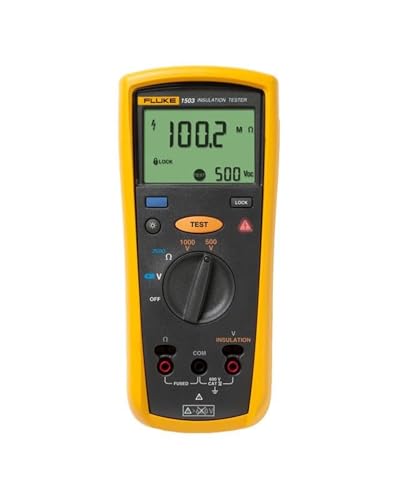
Fluke 1503 Insulation Resistance Tester
The 1503 shares the same form factor and basic mission as the 1507, but Fluke positions it as the simpler of the two: it offers only two insulation test voltages (500V and 1000V) instead of the 1507’s five, over a 0.01 MΩ to 2000 MΩ range, plus the same basic AC/DC voltage (0.1V-600V) and lo-ohms continuity (200mA) functions. If your work only ever calls for 500V or 1000V testing — common for general motor and cable insulation checks — the narrower range doesn’t cost you anything practical, and it’s a straightforward way to save money over the 1507’s broader voltage selection.
Fluke 1587 FC — Best Step-Up With Connectivity

The 1587 FC combines a full digital multimeter — voltage, current, resistance, capacitance, frequency, temperature, continuity, and diode testing — with insulation testing (the same 50V-1000V range as the 1507) in one instrument, and adds PI/DAR TrendIt graphs plus wireless data logging through the Fluke Connect app that saves measurements to your phone or the cloud. If you’re currently carrying both a multimeter and a separate insulation tester, consolidating into the 1587 FC can simplify your kit — the tradeoff is a notably higher price and a device that’s doing two jobs instead of specializing in one the way the 1507 does.
Fluke 1535 — Best for Higher Voltage Testing
When 1000V isn’t enough, the 1535 tests at user-selectable voltages of 250V, 500V, 1000V, and 2500V with resistance measurement up to 500 GΩ and automatic PI/DAR calculation, making it suited to heavier industrial equipment and higher-voltage installations that the 1507 simply isn’t rated to test. It’s a significant step up in both price and testing range, and most users won’t need it unless their work specifically calls for voltages above what the 1507 offers.
Things to Consider Before You Buy
Match the test voltage range to your actual work before comparing price tags. If you’re testing standard motors, cables, and general electrical equipment, the 1507’s 50V-1000V range covers nearly everything you’ll encounter, and paying more for a 2500V-capable instrument like the 1535 doesn’t buy you anything useful. If your work only ever needs 500V or 1000V testing, the 1503 covers that at a lower price without giving up much. On the other hand, if app-based PI/DAR trending or cloud record keeping is part of your workflow, the 1587 FC will save you time that the 1507 can’t.
Also factor in calibration requirements. If your employer or industry requires traceable calibration documentation, confirm that whatever unit you buy — new or used — includes a current certificate; for the 1507, that means specifically seeking out the “1507 CAL” model rather than the standard version, since re-calibrating an out-of-spec meter after the fact costs both time and money.
Related Guides
- Best Fluke multimeters
- Best multimeter
- Best multimeters for electricians
- How to test a motor with a multimeter
FAQ
Is the Fluke 1507 worth the price over a cheaper insulation-testing multimeter?
If insulation testing is a regular, significant part of your job, yes — the dedicated design and live circuit detection offer real advantages over a general multimeter with an insulation mode. If you only need occasional insulation checks, a combo multimeter/megohmmeter may be more practical.
What’s the difference between the Fluke 1507 and the Fluke 1503?
The core testing function and form factor are the same, but the 1503 offers only two insulation test voltages (500V and 1000V) versus the 1507’s five (50V, 100V, 250V, 500V, 1000V). If your work only ever needs the two higher voltages, the 1503 covers it at a lower price; if you also test at lower voltages, the 1507 is the more flexible choice.
Do I need the 1587 FC instead of the 1507?
Only if you want a single instrument that also functions as a full digital multimeter with wireless data logging. If you already carry a separate multimeter and just need dedicated insulation testing, the 1507 is the more focused and typically less expensive choice.
Prices and availability shown above are pulled live from Amazon and can change at any time. Always confirm the current price and specs on the product page before purchasing.
