
Cutting metal art is a different job from squaring up structural steel. Instead of raw amperage, what matters most is control at slow, deliberate speeds — a steady hand tracing a curve, a torch that doesn’t stutter on a tight radius, and consumables that don’t burn through mid-design. Several plasma cutters now build specifically around “drag-cut” torches designed to glide directly on thin sheet metal without a guide, which is exactly the kind of control freehand metal art and stencil work needs. We pulled the current Amazon lineup, checked real-time pricing and availability, and narrowed the field to the plasma cutters best suited to detailed, artistic cutting in 2026.
As an Amazon Associate, Power Tools Today earns from qualifying purchases. Prices and availability are accurate as of the date shown and are subject to change.
Quick Picks: Best Plasma Cutters for Metal Art
- Best Overall: LOTOS Apex LTP6300D 63A Drag-Cut Pilot Arc
- Best Built-In Air (No Compressor Needed): LOTOS Apex LTP5600CD 56A Drag-Cut
- Best Value Drag-Cut: LOTOS Apex LTP6010D 60A Drag-Cut
- Best Budget/Lightweight: Reboot RBC6000D 60A Plasma Cutter
- Best for Detail Work (Low Interference): YESWELDER 60A Non-HF Plasma Cutter
Quick Comparison: Key Specs
| Model | Price | Amps | Drag-Cut | Voltage | Best For |
|---|---|---|---|---|---|
| 1. LOTOS LTP6300D | $439.98 | 63A | Yes | 110V/220V | Overall pick |
| 2. LOTOS LTP5600CD | $599.98 | 56A | Yes | 120V/240V | Built-in air |
| 3. LOTOS LTP6010D | $249.98 | 60A | Yes | 110V/220V | Value drag-cut |
| 4. Reboot RBC6000D | $139.99 | 60A | No | 120V/240V | Budget/lightweight |
| 5. YESWELDER Non-HF | $279.99 | 60A | No | 110V/220V | Detail/low interference |
| 6. Forney 251 20 P | $553.12 | 20A | No | 120V only | Thin-gauge/beginner |
| 7. Amico CUT-50HF | $349.00 | 50A | No | 100-250V | Price-to-power ratio |
| 8. AHP Alpha-Cut 825i | $625.00 | 60A | No | 110V/220V | Pilot-arc consistency |
| 9. PRIMEWELD CUT60 | $699.00 | 60A | No | 110V/220V | Warranty/thicker capacity |
| 10. HITBOX CT-520 | — | 50A | No | 110V/220V | Multi-process combo |
Prices above are pulled live from Amazon and may have changed since — click a model name or the Amazon product card below for the current price.
1. Best Overall: LOTOS Apex LTP6300D 63A Drag-Cut Pilot Arc

The LTP6300D is built around exactly what metal art demands: a drag-cut torch that glides directly on the workpiece for straight templates and smooth freehand curves, paired with LOTOS’s DC6309 drag consumables for cleaner edges than a standard torch held at a distance. At 63A it has real headroom — 3/4″ clean cuts and 1″ severance on steel, stainless, aluminum, and copper — so it doesn’t max out on thicker stock between art pieces. A non-HF blowback pilot arc keeps electrical interference low (useful in a home garage with other electronics running) while still piercing through paint, rust, and expanded mesh reliably.
| ✅ Pros | ❌ Cons |
|---|---|
| • Purpose-built drag-cut torch for freehand art work • Strong 63A headroom for both thin sheet and thicker stock • Low-interference non-HF pilot arc start | • Higher price than the value-focused picks here • Drag consumables sold separately |
2. Best Built-In Air (No Compressor Needed): LOTOS Apex LTP5600CD 56A Drag-Cut
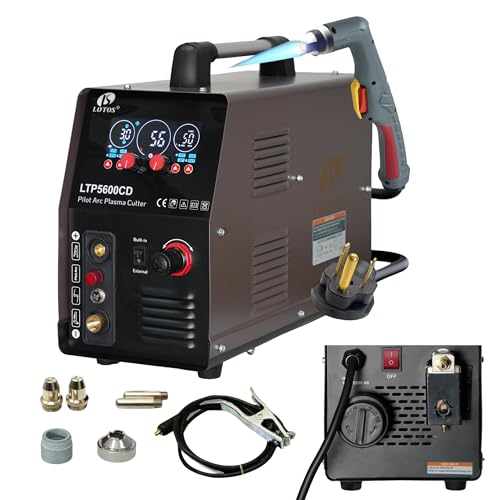
An onboard air pump means no hauling a separate compressor to the garage, driveway, or a remote job site — plug it in and start cutting. The LTP5600CD keeps the same drag-cut philosophy as its siblings, letting the torch nozzle rest and glide on thin sheet for stencils and signmaking, and it scales up: run on internal air for portability up to 1/2″ steel, or plug in an external compressor to unlock the full 56A envelope for 5/8″ clean cuts. A non-touch pilot arc handles painted or rusted stock without nozzle sticking, which matters for reclaimed or found-metal art projects.
| ✅ Pros | ❌ Cons |
|---|---|
| • Built-in air pump — no separate compressor required • Scales up to 56A with an external compressor • Non-touch pilot arc handles rusted or painted stock | • Internal air alone limits cut thickness to 1/2″ • Premium price for the drag-cut category |
3. Best Value Drag-Cut: LOTOS Apex LTP6010D 60A Drag-Cut

This is the middle ground in LOTOS’s drag-cut lineup — 60A of output, the same touch-and-go tracking for straighter lines and cleaner curves on thin sheet, and a claimed 20% faster cutting speed than the brand’s standard torches, priced well under the flagship LTP6300D. Dual-voltage sensing switches automatically between 120V for quick home projects and 240V for full 60A output when more power is available, and a 1-minute setup with a pre-installed regulator gets it running fast without extra parts to source.
| ✅ Pros | ❌ Cons |
|---|---|
| • Drag-cut control at a lower price than the flagship LOTOS • Claimed 20% faster cutting for workshop productivity • Automatic dual-voltage sensing | • Less cut capacity than the 63A flagship • Still a mid-range price versus the true budget picks below |
4. Best Budget/Lightweight: Reboot RBC6000D 60A Plasma Cutter

At 8.69 lbs, the RBC6000D is genuinely easy to carry between a workbench and a project on the floor — a real advantage when metal art means moving the tool around a piece rather than the other way around. It’s explicitly marketed for automotive repairs and metal art with beginner-friendly controls: intuitive amperage adjustment and clear PSI guidance rather than a dense menu of settings to learn first. It doesn’t have a dedicated drag-cut torch like the LOTOS picks above, but at a budget-friendly price point it’s an accessible entry point for someone starting out in plasma-cut art.
| ✅ Pros | ❌ Cons |
|---|---|
| • Lowest price on this list • Under 9 lbs, easy to move around a piece • Beginner-friendly, uncomplicated controls | • No dedicated drag-cut torch • Less established brand track record than LOTOS |
5. Best for Detail Work (Low Interference): YESWELDER 60A Non-HF Plasma Cutter

YESWELDER markets this one explicitly for intricate metalwork and DIY art projects, and the non-high-frequency “blow-back” start system is the reason why — it avoids the electrical interference that HF-start torches can cause with nearby electronics, which matters in a home studio or garage running other equipment. A non-touch pilot arc torch cuts through rough, painted, or rusty surfaces without needing to touch the tip to the metal, and a digital display with real-time air pressure and current readouts helps dial in consistent, repeatable settings across a multi-piece project.
| ✅ Pros | ❌ Cons |
|---|---|
| • Non-HF start reduces interference with nearby electronics • Marketed specifically for intricate/art metalwork • Digital display for repeatable settings | • No dedicated drag-cut torch • Mid-range price without the LOTOS drag-cut advantage |
6. Best for Thin-Gauge Detail/Beginner Work: Forney Easy Weld 251 20 P Plasma Cutter

Forney 251 Easy Weld 20 P Plasma Cutter - Portable and Versatile Cutting Tool for Precise Metal Cutting
Forney is a long-standing US brand with wide retail support, and the 251 20 P strips a plasma cutter down to the essentials for someone just getting started with detail cutting: 20A output on 120V household power only, a 1/4″ clean-cut rating that suits thin-gauge art sheet rather than structural stock, and a plug-and-play setup with minimal controls to learn. At around 13 lbs it’s easy to move around a small piece, and the contact-start pilot arc keeps electrical interference to a minimum in a home shop.
| ✅ Pros | ❌ Cons |
|---|---|
| • Simplest learning curve of any pick here • Lightweight (~13 lbs) and fully portable • Established, widely-supported US brand | • 20A/1/4″ ceiling limits it to light-gauge art metal only • No dedicated drag-cut torch, standoff distance takes practice |
7. Best Price-to-Power Ratio: Amico CUT-50HF Air Plasma Cutter

The CUT-50HF delivers 50A of cutting power at one of the lowest prices in this roundup, with a wide 100-250V auto-sensing input that works on any standard outlet without a manual voltage switch — convenient for moving between a home outlet and a shop’s 220V circuit. It’s a non-touch HF pilot arc design, so it carries more RF noise potential than the blowback-style torches on this list, worth factoring in if you run sensitive electronics nearby. Amico has several closely related CUT-50 model variants on Amazon with differing published specs, so it’s worth double-checking the exact listing’s clean-cut rating before buying.
| ✅ Pros | ❌ Cons |
|---|---|
| • Strong 50A output at a budget price • Wide 100-250V input works on any standard outlet • No manual voltage switching needed | • HF pilot arc adds more electrical noise than non-touch/blowback designs • Amico has multiple similar-looking CUT-50 listings, confirm specs before ordering |
8. Best for Pilot-Arc Consistency: AHP Alpha-Cut 825i Plasma Cutter
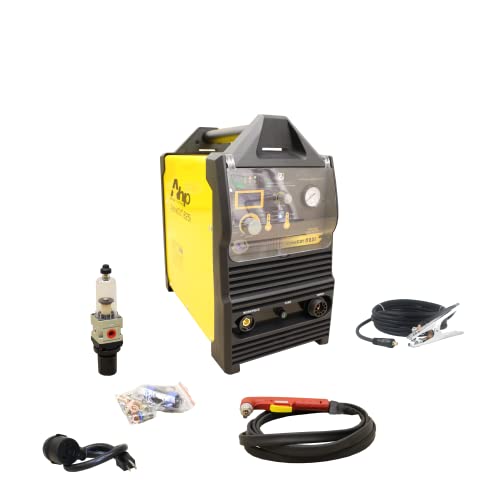
The Alpha-Cut 825i has built a following among the CNC plasma table community for reliable, repeatable pilot-arc strikes — a trait that also pays off in freehand detail work, where a torch that fires consistently every time keeps a design’s line quality even across a long cutting session. It’s rated for 60A with clean cuts up to 7/8″, runs on 110V or 220V, and ships as a complete kit ready to use out of the box. It has fewer Amazon reviews than the more mainstream brands on this list, with more of its reputation built on welding-forum testimonials than the Amazon listing itself, and like most in this class it uses an HF-style pilot arc rather than a blowback start.
| ✅ Pros | ❌ Cons |
|---|---|
| • Reputation for reliable, repeatable pilot-arc strikes • Strong 7/8″ clean-cut capacity at 60A • Complete kit, compact and lightweight for its class | • Fewer Amazon reviews than mainstream competitors • HF-style pilot arc, interference not fully eliminated |
9. Best Warranty / Thicker Capacity: PRIMEWELD CUT60 Plasma Cutter

PrimeWeld backs the CUT60 with a 3-year warranty, longer than most competitors on this list, and pairs it with a well-reviewed PT60 non-touch pilot arc torch on 110V/220V dual voltage. At 60A it has enough headroom to move up to thicker art stock — reviewers commonly report clean cuts in the 5/8″-3/4″ range — while still dialing down for thin-gauge detail work. It uses a standard standoff torch rather than a dedicated drag-cut design, so freehand stencil lines take more practice than on the drag-cut LOTOS picks, and the HF pilot arc adds some RF noise near sensitive electronics.
| ✅ Pros | ❌ Cons |
|---|---|
| • 3-year warranty, longer than most competitors here • Headroom for thicker art stock (up to ~3/4″ per reviewers) • Well-reviewed, established brand with active seller support | • Standard standoff torch, not drag-cut • HF pilot arc adds RF noise near sensitive electronics |
10. Best Multi-Process Combo: HITBOX CT-520 Plasma/TIG/Stick Combo

For an artist who also welds their pieces together rather than just cutting them, the CT-520 folds 50A plasma cutting, pulse TIG with a foot pedal, and stick/MMA welding into one machine on 110V/220V — one box covers cutting, detail welding, and repair work instead of three separate tools. A large LED display and HF non-touch pilot arc round out the feature set. Combo machines are a newer category with a thinner long-term reliability track record than single-purpose cutters, and jack-of-all-trades designs typically don’t match a dedicated unit’s performance on any one process, so duty-cycle claims are worth treating with some caution until more owner reports accumulate.
| ✅ Pros | ❌ Cons |
|---|---|
| • One machine covers plasma cutting, pulse TIG, and stick welding • Foot pedal control for detail TIG work • Good value for artists who fabricate as well as cut | • Newer combo-unit category, thinner reliability track record • Multi-process machines typically underperform dedicated single-purpose units |
Things to Consider Before You Buy
Drag-cut vs. standoff torches: A drag-cut torch is designed to rest directly on thin sheet metal for straighter freehand lines — a real advantage for stencil work, signmaking, and detailed art. A standard torch needs a small standoff gap, which is harder to hold consistent by hand on intricate curves.
Amperage vs. control: More amps means more cutting capacity, but metal art on thin gauge sheet rarely needs the full range of a high-amp machine. What matters more is stable arc control at lower settings — check that a machine’s amperage range actually dials down low enough for the gauge you work with most.
HF vs. non-HF pilot arc: High-frequency start torches can interfere with nearby electronics (computers, remotes, sensitive shop equipment). A non-HF blowback-start torch avoids that at a small tradeoff in arc-start reliability on very dirty or rusted material.
Built-in air vs. external compressor: A machine with an onboard air pump is more portable and setup-free, but typically caps out at a lower cut thickness than the same machine running on an external compressor at full pressure.
Newer or budget-brand listings: Less established brands can be a great value, but published clean-cut and duty-cycle specs are worth double-checking against the exact listing before buying — some budget and combo-unit listings vary their claims across near-identical model variants.
Related Guides
- Best plasma cutters
- How to use a plasma cutter
- How thick can a plasma cutter cut?
- Plasma cutter vs angle grinder
FAQ
What amperage plasma cutter is best for metal art?
Most metal art work is done on thin to mid-gauge sheet, so a 40-60A machine with good low-end control covers the vast majority of projects. Higher amperage adds headroom for thicker stock but isn’t the deciding factor for detail work.
Do I need a drag-cut torch for metal art?
Not strictly, but it helps significantly with freehand control — resting the torch directly on the workpiece steadies your hand and produces straighter lines and smoother curves than holding a standard torch at a standoff distance.
Can a plasma cutter cut intricate shapes and stencils?
Yes, with practice and a steady hand — or a torch designed for it. Many metal artists start with simple templates or straightedges to guide the torch before moving to freehand cuts as they build control.
Prices and availability shown above are pulled live and may change — always confirm the current price on Amazon before buying.