
As an Amazon Associate, Power Tools Today earns from qualifying purchases. Prices and availability are accurate as of the date shown and are subject to change.
A multimeter is one of those tools that sits in a drawer for months at a time — and then saves you hundreds of dollars the moment you need it. Checking whether an outlet is live before you start drilling, figuring out why a light fixture stopped working, testing a battery to see if it is actually dead, tracing a circuit before calling an electrician — these are the everyday situations where a multimeter pays for itself.
The good news for homeowners is that you do not need a $300 professional instrument to handle household electrical tasks. A well-chosen meter in the $30–$80 range covers everything a DIY homeowner encounters, and it will last for years sitting in a toolbox between uses. The bad news is that the sheer number of options on Amazon and at hardware stores makes picking the right one genuinely confusing.
We sorted through the noise and selected ten meters that cover every level of home use — from a simple first meter that gets the job done safely, to an upgrade-worthy option for the homeowner who genuinely enjoys tackling electrical projects. Every meter on this list has a legitimate CAT safety rating, an auto-ranging function that removes guesswork, and a backlit display that works in the dim spaces where home electrical problems tend to live.
⚡ Quick Picks at a Glance
Jump to any pick → click the product name.
| Product | Badge | Best For | Price | Link |
|---|---|---|---|---|
| Fluke 117 | ⭐ Best Overall | Serious DIYers who want a professional-grade meter for home use | Check Price → | |
| Klein MM325 | 💰 Best Value | Homeowners who want a solid, safe meter without overspending | Check Price → | |
| KAIWEETS HT118A | 🎯 Best Budget | Budget-conscious buyers who still want proper safety ratings | Check Price → | |
| Greenlee DM-45 | 🔧 Best Home + Light Pro | Homeowners who also do weekend trade work or live in older homes | Check Price → | |
| Klein MM320KIT | 🧰 Best Starter Kit | First-time buyers who want multimeter + NCV tester + outlet tester | Check Price → | |
| Crenova MS8233D | 🏷️ Best Ultra-Budget | Occasional users who need a safe meter and spend as little as possible | Check Price → | |
| AstroAI 6000 | 🔬 Best for Hobbyists | Electronics hobbyists who want higher resolution and extra functions | Check Price → | |
| Fluke 107 | 📦 Best Pocket Meter | Homeowners who want a slim, portable Fluke that stores easily | Check Price → | |
| Extech EX330 | 📐 Best Slim Mid-Range | Homeowners who want a compact meter with temperature and NCV | Check Price → | |
| Amprobe PK-110 Kit | 🎁 Best Bundle | Homeowners who want multimeter, NCV stick, and outlet tester in one kit | Check Price → |
🔎 How We Chose: What Homeowners Actually Need
A homeowner’s multimeter requirements are genuinely different from a professional electrician’s. You are not doing it every day. You are not working on 480V commercial switchgear. You are probably testing outlets, checking whether a circuit is live before you cut into a wall, figuring out why a light stopped working, testing batteries, or tracing a circuit that keeps tripping a breaker. These tasks have specific requirements, and we selected every meter on this list against those criteria.
Safety Rating: CAT II at minimum, CAT III preferred. Every meter on this list is rated for residential electrical environments. CAT II covers outlet-level and appliance-level work — plugging probes into wall receptacles, testing cords, checking small appliances. CAT III covers the distribution panel, branch circuit wiring, and fixed installations in a home. We prefer CAT III for any homeowner who might ever open their breaker panel, which most do at some point. We excluded any meter without a documented, verified safety rating — uncertified meters are a safety hazard regardless of price.
Auto-Ranging. A homeowner who uses a multimeter a few times a year does not want to memorize voltage ranges. Auto-ranging means you turn the dial to “V AC” or “V DC,” touch the probes to the circuit, and read the number. Every meter on this list is auto-ranging unless specifically noted. For occasional home use, this is not optional.
Non-Contact Voltage Detection (NCV). The ability to hold the meter near a wire or outlet and see whether it is live — without touching anything — is the single most valuable safety feature for homeowners. Before you disconnect a wire, reach into a junction box, or start cutting drywall, a quick NCV check tells you whether the circuit is actually off. We gave preference to meters with NCV built into the meter body or included in the kit.
Backlit Display. Electrical panels, crawl spaces, attic junction boxes, and cabinet interiors are dark. A meter without a backlight is genuinely frustrating in these spaces. Every meter we recommend has a clear backlit display.
Ease of Use. A homeowner who uses a multimeter twice a year should be able to pick it up, figure out what they need to do, and get a reading without consulting a manual. We evaluated how intuitively each meter is organized and how clearly the functions are labeled.
Value, Not Just Price. Spending $15 on a meter with no safety certification is not a bargain — it is a risk. Spending $300 on a Fluke 87V is overkill for checking whether an outlet works. We matched each recommendation to the level of home use that justifies it, ranging from an honest ultra-budget pick under $25 to a professional-grade upgrade for serious DIYers.
🔧 Full Reviews: Best Multimeters for Home Use (2026)

✅ Serious DIYers who wire their own fixtures, add circuits, troubleshoot their own electrical issues, and want a professional-grade meter that handles anything they encounter at home.
❌ Homeowners who only use a meter occasionally for basic tasks — the Klein MM325 () or KAIWEETS HT118A () covers those needs at a fraction of the price.
🔑 The AutoVolt mode automatically detects AC or DC — useful when you are moving between outlets, light switches, and battery compartments without thinking about which mode to use. The LoZ (low impedance) mode drains ghost voltages that capacitively-coupled house wiring often generates on de-energized circuits, giving you a definitive answer about whether a circuit is actually off before you start working. VoltAlert non-contact voltage detection is built directly into the meter body — a quick sweep near a wire or outlet tells you whether it is live before any probe contact. True-RMS ensures accurate readings on the modern dimmer switches, LED drivers, and smart home devices that generate non-sinusoidal waveforms increasingly common in homes. Fluke’s three-year warranty means this meter handles a lifetime of typical home use without question.
👍 Professional-grade accuracy and build quality for home use; LoZ eliminates ghost voltage confusion; NCV built in; True-RMS for modern home electronics; compact and comfortable; 3-year Fluke warranty.
👎 More expensive than most homeowners need (); no temperature measurement; tops out at 600V (not a limitation for residential use).
🛒
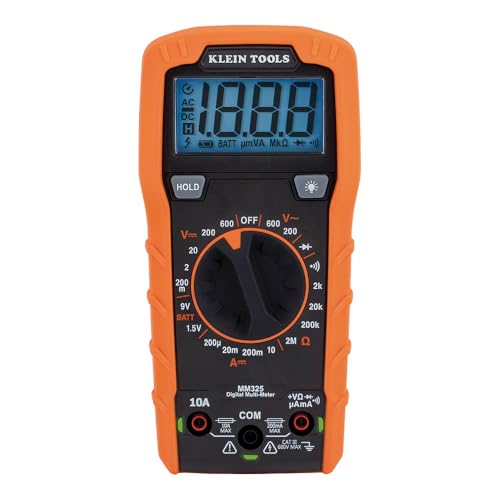
✅ Homeowners who want a reliable, safe meter from a trusted brand for general household electrical tasks — outlet testing, battery checking, circuit continuity, and basic wiring work.
❌ Homeowners who specifically need NCV built into the meter body (the MM325 does not include it); for that, consider the Klein MM320KIT () or the KAIWEETS HT118A ().
🔑 Klein has supplied tradespeople with quality hand tools since 1857, and the MM325 reflects that heritage in a meter sized and priced for homeowner use. AC and DC voltage to 600V, DC current to 10A, and resistance to 2 MΩ cover everything a homeowner measures. Continuity testing with an audible beep tells you instantly whether a circuit is complete. The LED confirmation lights on the meter face indicate correct test lead placement — reducing the chance of connecting leads in the wrong order and getting a confusing reading. The battery testing function is a practical addition. Auto-ranging handles range selection automatically.
👍 Klein brand reliability; LED lead placement confirmation for safety; CAT III 600V; auto-ranging; battery test function; clear backlit display; price is competitive for a professional-brand meter.
👎 No NCV built in (requires a separate tester for live-wire checking); no temperature measurement; basic feature set compared to upper mid-range options.
🛒
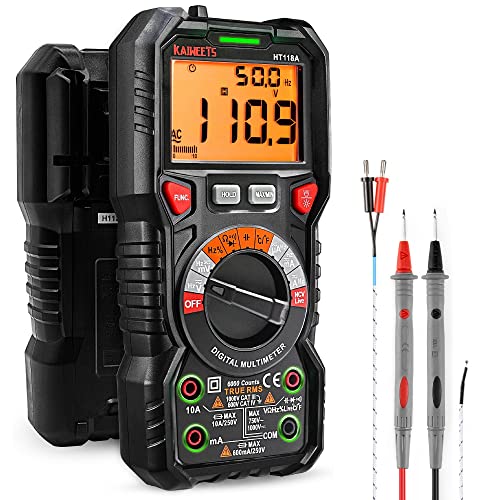
✅ Budget-conscious homeowners who want a safe, feature-rich meter for occasional home electrical tasks without paying mid-range prices.
❌ Long-term professional daily use — the HT118A is well-built for a budget meter, but it does not have the track record or warranty support of Fluke or Klein for heavy use.
🔑 The 6,000-count display provides better resolution than the 4,000-count displays on many budget competitors. True-RMS measurement handles the non-sinusoidal waveforms that LED dimmers, inverters, and smart home devices generate — relevant even for home use as these loads become more common. NCV non-contact voltage detection is built into the meter body for safe live-wire checks. Temperature measurement via K-type thermocouple and capacitance testing add versatility. KAIWEETS backs the HT118A with a 3-year warranty — exceptional at this price and a meaningful indicator of the company’s confidence in the product.
👍 True-RMS and NCV at; 6,000-count display; temperature and capacitance included; 3-year warranty (exceptional for this price tier); legitimate CAT III safety rating; strong feature-to-price ratio.
👎 Build quality and feel are below Fluke and Klein; long-term durability under heavy use is less proven; brand support network less established than major US brands.
🛒
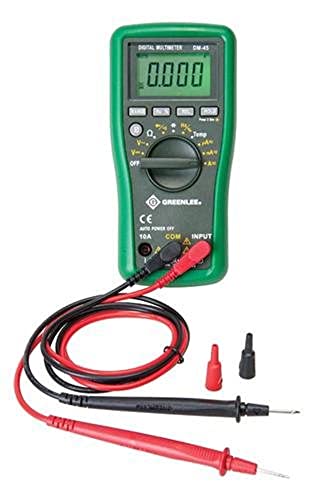
✅ Homeowners in older homes with complex wiring, DIYers who frequently add circuits or do wiring projects, and anyone who straddles home use and occasional professional-adjacent tasks.
❌ Strictly occasional users who just need to check an outlet or test a battery — simpler and cheaper options like the Klein MM325 () or KAIWEETS HT118A () serve that use case better.
🔑 The gripped rubber over-mold cover provides a secure, comfortable hold that matters when you are working in tight panel spaces or awkward positions. The backlit display is notably bright and high-contrast, making it one of the easiest meters to read in poor lighting. Non-contact voltage detection is built in. AC and DC voltage to 600V, current to 10A, resistance, continuity, capacitance, frequency, and diode testing are all included. The built-in stand and hanger hook allow the meter to be propped up or hung in a working position, freeing both hands for probe work — a practical detail that most basic meters omit.
👍 Excellent rubber grip and ergonomics; bright high-contrast backlit display; NCV built in; built-in stand and hanger hook; professional Greenlee build quality; is reasonable for the feature set.
👎 No True-RMS; no temperature measurement; warranty terms less prominent than Fluke or Klein; slightly bulkier than slim meters.
🛒

✅ New homeowners building their first electrical tool kit who want a ready-to-use combination of a multimeter, NCV tester, and outlet tester in one purchase.
❌ Homeowners who already own an NCV tester or outlet tester and just need a multimeter; buying them separately would not add value at that point.
🔑 The Klein MM300-based multimeter measures AC and DC voltage to 600V, DC current to 10A, and resistance to 2 MΩ with continuity and diode testing. The included non-contact voltage tester lets you check for live wires quickly and safely without using the multimeter probes. The outlet tester is the hidden gem of this kit: it plugs directly into a wall outlet and indicates via LED pattern whether the outlet is correctly wired, reversed polarity, open ground, or open neutral — common wiring faults that cause mysterious appliance and electronics problems. Test leads and batteries are included so the kit is ready to use out of the box.
👍 Three complementary tools for; outlet tester identifies wiring faults directly; NCV tester faster than multimeter for live-wire checks; complete kit ready out of the box; Klein brand quality; excellent homeowner starting point.
👎 The MM300 multimeter in the kit is basic (no True-RMS, no temperature, no capacitance); not suitable as a standalone upgrade for experienced DIYers who want a more capable primary meter.
🛒

✅ Budget-conscious homeowners who need a safe, functional meter for occasional basic use and have no need for advanced features.
❌ Anyone doing frequent or technically demanding electrical work — the MS8233D is a starter meter, not an upgrade path.
🔑 The MS8233D covers the core measurements a homeowner needs: AC and DC voltage, resistance, continuity with audible beep, capacitance, frequency, and diode testing. The non-contact live wire detection is built in — hold the meter near a wire or outlet and the indicator alerts you if it is energized. Auto-ranging handles measurement selection automatically. The rotary dial design is deliberately simplified, covering the main measurement modes without overwhelming a first-time user. Within the DIY and home improvement community, the MS8233D has accumulated a strong reputation over many years for reliable accuracy on the measurements that homeowners actually use. At, it is the right starting point for anyone unsure whether they will use a multimeter enough to justify a larger investment.
👍 NCV built in; auto-ranging; covers all basic home measurements; easy for beginners; consistently accurate on core measurements; very affordable at.
👎 No True-RMS; build quality is basic; no temperature measurement; shorter warranty; not suited to frequent or demanding use; leads quality is basic.
🛒

✅ Homeowners who combine household electrical maintenance with electronics hobbyist work and want a single meter at that handles both effectively.
❌ Strictly household electrical work where the advanced functions go unused; the Crenova () or KAIWEETS HT118A () is a better value for pure home use without the hobby electronics component.
🔑 The 6,000-count display resolves finer differences in voltage and current readings — relevant when you are checking sensor outputs, battery cell voltages, or low-voltage DC circuits where precision matters. True-RMS handles the non-sinusoidal waveforms generated by switch-mode power supplies, LED drivers, and many other hobbyist electronics accurately. The transistor gain (hFE) function allows direct testing of NPN and PNP transistors — useful when sorting through component drawers or troubleshooting analog circuits. Temperature measurement via K-type thermocouple, duty cycle measurement for PWM circuit work, capacitance testing, and built-in NCV for household electrical safety checks round out the feature set.
👍 6,000-count display for better resolution; True-RMS; transistor gain (hFE) test for electronics hobbyists; temperature, duty cycle, and capacitance included; NCV built in; excellent value at.
👎 Not auto-ranging on all functions (some manual range selection required on certain modes); AstroAI’s long-term durability track record less proven than Fluke or Klein; leads quality is basic.
🛒

✅ Homeowners who want a true Fluke meter in the most compact form factor possible — to keep in a kitchen drawer, toolbox, or travel kit where space is at a premium.
❌ Anyone who needs capacitance testing, temperature measurement, or NCV built in — the 107 is stripped down for compactness. At, you are paying for Fluke brand and form factor; for more features at lower cost, the KAIWEETS HT118A () is a better value.
🔑 The Fluke 107 is built on the philosophy that a compact, always-available meter beats a more capable one that lives on a shelf because it is too bulky. It measures AC and DC voltage to 600V and handles resistance and continuity — the measurements that cover the large majority of homeowner electrical tasks. One-hand operation is possible thanks to the slim, ergonomic profile. True-RMS handles non-sinusoidal AC signals accurately. The backlit display is clear and readable in low-light spaces. Auto-ranging makes operation straightforward. Fluke backs the 107 with a three-year warranty.
👍 The most compact Fluke on this list; slim enough for a pocket or small drawer; True-RMS; Fluke reliability and 3-year warranty; easy one-hand operation; auto-ranging.
👎 No NCV; no capacitance; no temperature; no current measurement beyond basic continuity; is a premium price for the reduced feature set compared to alternatives.
🛒

✅ Homeowners who want NCV, temperature, and capacitance in a compact, slim meter that does not take up much toolbox space — and are comfortable spending for a mid-range feature set.
❌ Homeowners who want True-RMS (the EX330 does not include it) or who need the professional build quality of Fluke or Klein for heavy use.
🔑 The Extech EX330 packs 12 measurement functions into a mini form factor that measures noticeably smaller than most competitors. Non-contact voltage detection is built in for quick live-wire checks. Temperature measurement via Type-K thermocouple covers the range needed for home diagnostics. Capacitance testing and frequency measurement are included. Auto-ranging handles measurement selection. The backlit display is easy to read. Extech/FLIR’s brand backing provides reliability assurance above pure budget brands. The combination of NCV, temperature, capacitance, and a compact form factor in a package is the EX330’s specific value proposition.
👍 Compact mini form factor; 12 functions including temperature, NCV, and capacitance; Extech/FLIR brand backing; auto-ranging; backlit display; good mid-range value at.
👎 No True-RMS; build quality is mid-range, not professional grade; warranty terms are basic; not suited for demanding professional use.
🛒

✅ Homeowners who want a complete starting kit with a multimeter, NCV tester, and outlet tester for — particularly useful for those moving into a new home and doing a thorough electrical checkup.
❌ Advanced DIYers who need higher measurement capability; the AM-420 multimeter in the kit is a capable basic tool but is not a professional-grade meter for demanding work. Note that the AM-420 tops out at 250V AC, which covers all US home outlets but is less headroom than full 600V meters.
🔑 The Amprobe PK-110 kit contains three tools that address the most common homeowner electrical diagnostic needs. The AM-420 multimeter is an auto-ranging meter that measures AC and DC voltage, current, resistance, continuity, and diode test. The VP1000B non-contact voltage stick provides a fast, safe live-wire check — a dedicated, single-purpose tool that is faster to use than a multimeter for simply confirming whether a circuit is energized. The ST102B socket tester plugs directly into wall outlets and identifies correct wiring, reversed polarity, open ground, open neutral, and open hot using a three-LED pattern — a complete outlet health check in seconds. The combination is particularly valuable when moving into a home with unknown electrical history. All three tools come ready to use. Fluke Corporation ownership of Amprobe provides a level of quality assurance that pure budget brands cannot match.
👍 Three complementary tools for; outlet tester identifies wiring faults instantly; NCV stick is faster for live-wire checks; Fluke-owned brand quality; ready to use out of the box; excellent value for a complete homeowner electrical kit.
👎 The AM-420 multimeter tops out at 250V AC (sufficient for US home use but not full 600V range); no capacitance or temperature in the multimeter; not a substitute for a full-function meter for serious DIY work.
🛒
The most important question to answer before buying a home multimeter is honest: how often will you actually use it, and what will you use it for? That answer determines how much to spend and which features matter.
If you are a , the Klein MM320KIT () or Amprobe PK-110 Kit () gives you the most complete starting setup. The outlet tester included in both kits is genuinely valuable for checking the outlets in a new home, and having a dedicated NCV tester is faster and simpler than using the multimeter for live-wire checks.
If you only want a , the Crenova MS8233D () or KAIWEETS HT118A () is the right starting point. The HT118A adds True-RMS, a 6,000-count display, and a 3-year warranty at — a strong jump in capability for not much more money.
If you are a , spend the money on the Fluke 117 (). The LoZ mode alone — which eliminates the ghost voltage false readings that cause homeowners to second-guess whether a circuit is actually off — is worth the premium for anyone who opens junction boxes or works in panels. You will use this meter for a decade or more, and it will pay for itself quickly in avoided electrician calls.
If you want a , the Extech EX330 () or KAIWEETS HT118A () both hit a strong value point. The HT118A adds True-RMS and a longer warranty at a lower price.
If you also do alongside home maintenance, the AstroAI 6000 () is the right choice. Its transistor test function, 6,000-count resolution, and True-RMS make it genuinely more capable for component-level electronics work than any other meter in the home-use price range.
If and you want a meter that stores almost anywhere, the Fluke 107 () is the answer. It is genuinely pocket-sized and delivers Fluke quality and warranty in a form factor that removes every objection about bulky tools.
For professional electricians, see our dedicated guide: . If you use your multimeter for automotive diagnostics, check out our guide. For the best overall picks across all categories, see our roundup.
Do I really need a multimeter as a homeowner?
If you ever check whether an outlet is working, try to figure out why a light stopped working, test a battery before throwing it away, or do any wiring work yourself, then yes — a multimeter saves time and money. A basic model at–$30 costs less than one electrician service call and handles the diagnostic work that would otherwise require waiting for a professional. For homeowners who do any DIY electrical work at all, it is one of the most cost-effective tools in the home.
What can a homeowner actually do with a multimeter?
The most common home uses are testing batteries (AA, AAA, 9V, and car batteries) to see if they are actually dead; checking whether an outlet is providing power; verifying a circuit is actually off at the breaker before doing wiring work; testing continuity to check whether a fuse is blown or a wire is broken; checking whether a light switch is passing voltage correctly; diagnosing whether a small appliance is getting power; and measuring voltage at the panel to check for a low-voltage problem. More advanced DIYers also use them for adding circuits, running new wire, and troubleshooting more complex wiring issues.
Is it safe for a homeowner to use a multimeter in a breaker panel?
With proper precautions, yes. The main rule is never touch the main service entrance conductors — the thick wires coming into the top of the panel from the utility — as those are always live regardless of the main breaker position. The individual circuit breakers and wiring below them can be safely tested with a properly rated (CAT III 600V) multimeter if you are careful to touch only one probe to a conductor at a time, avoid contact with any metal that may be energized, and work with one hand when possible. If you are unsure about any specific situation, call an electrician rather than guessing.
What is the difference between CAT II and CAT III for a home meter?
CAT II covers appliances, portable equipment, and receptacle-level work — plugging into outlets, testing cords and small appliances. CAT III covers fixed wiring in a building, including branch circuits, junction boxes, and the distribution side of breaker panels. For a homeowner who only checks batteries and outlets, CAT II is technically sufficient. For anyone who might open a junction box, work near wiring in a panel, or do any work on fixed house wiring, CAT III is the appropriate minimum safety rating. Most of the meters on this list are CAT III.
Do I need True-RMS for home use?
For most basic homeowner tasks — checking outlet voltage, testing batteries, verifying continuity — True-RMS makes no practical difference. It matters when measuring AC loads that generate non-sinusoidal waveforms: LED dimmers, inverters, variable-speed motors, and many modern electronics fall into this category. As these loads become more common in homes, True-RMS has become more relevant even for homeowners. If budget allows, choosing a True-RMS meter is worthwhile. The KAIWEETS HT118A () offers True-RMS at a budget price — no need to spend more just to get this feature.
What is non-contact voltage detection and do I need it?
Non-contact voltage detection (NCV) allows the meter to sense whether a wire or outlet is live simply by holding it nearby — no probe contact required. The meter gives an audible and visual alert when it detects voltage. For homeowners, NCV is one of the most practically useful safety features: before you reach into a junction box, cut a wire, or start any work near wiring, a quick NCV sweep confirms whether the circuit is actually off. We recommend choosing a meter or kit that includes NCV for anyone who plans to do any home wiring work.
What is an outlet tester and should I have one?
An outlet tester is a small plug-in device that you push into a wall outlet. Three indicator LEDs display a pattern that tells you whether the outlet is correctly wired, has reversed polarity (hot and neutral wires swapped), has an open ground, has an open neutral, or has an open hot. These wiring faults are more common in older homes than most people expect, and they cause mystery problems with electronics, appliances, and home networks. A simple outlet tester — like the ones included in the Klein MM320KIT () and Amprobe PK-110 Kit () — costs very little and quickly identifies problems that would otherwise require an electrician to diagnose. For anyone moving into an older home, testing every outlet takes about ten minutes and is well worth doing.
How do I test whether an outlet is working with a multimeter?
Set the multimeter to AC voltage (VAC) — it will auto-range to the correct setting. Insert the black probe into the larger slot on the left side of the outlet (neutral) and the red probe into the smaller slot on the right (hot). A working 120V US outlet should read between 115V and 125V AC. If you read near zero, the outlet is not receiving power — check the breaker and any GFCI outlets on the same circuit (GFCI outlets have a reset button and can cut power to other outlets when tripped). A reading significantly above or below the 115-125V range indicates a voltage problem that may warrant an electrician’s inspection.
Our Final Recommendation
For most homeowners, the right answer depends on how seriously you take DIY electrical work. If you do occasional projects and want the best possible meter that handles anything you encounter at home, the Fluke 117 () is the choice. It will be the last multimeter you ever buy for home use.
If you want strong value at a reasonable price with proper safety ratings and a trusted brand, the KAIWEETS HT118A () is the strongest budget recommendation — True-RMS, NCV, 6,000 counts, and a 3-year warranty at a mid-budget price is genuinely hard to beat.
For new homeowners building their first electrical kit, the Klein MM320KIT () provides the most complete starting setup, with the outlet tester being the feature that separates it from a simple meter purchase. That outlet tester may be the most practically useful electrical tool you own in the first year of home ownership.
Whatever you choose, make sure it carries a CAT II or CAT III safety rating from a recognized testing organization, has an auto-ranging function so you can use it without consulting a manual, and has a backlit display for the dark corners where electrical problems tend to hide. Those three features apply to every meter on this list — and they should apply to any meter you consider outside of it.
