
An oscillating belt sander earns its place on a bench the moment you need to smooth a curved chair leg, clean up a scroll-sawn edge, or shape a contour that a flat-platen sander just can’t reach. Unlike a handheld belt sander, these machines combine a moving belt with a side-to-side oscillating motion that clears dust faster, resists loading, and keeps you from burning the wood on detail passes. We pulled the current Amazon lineup, checked real-time pricing and availability, and narrowed the field down to the machines that actually put a belt to work with genuine oscillating motion — not spindle-only sanders wearing the same category tag. Here are the 5 worth your bench space in 2026.
As an Amazon Associate, Power Tools Today earns from qualifying purchases. Prices and availability are accurate as of the date shown and are subject to change.
Quick Picks: Best Oscillating Belt Sanders
- Best Overall: WEN 6524 Oscillating Belt and Spindle Sander
- Best Value: VEVOR Oscillating Belt and Spindle Sander (2400RPM)
- Best Variable Speed: Woodskil Oscillating Belt and Spindle Sander
- Best Heavy-Duty: Ridgid EB4424 Oscillating/Edge Belt Sander
- Best Premium/Industrial: JET Black 6″x89″ Oscillating Edge Sander
Quick Comparison: Key Specs
| Model | Price | Belt Size | Motor | Spindle Too? | Best For |
|---|---|---|---|---|---|
| 1. WEN 6524 | $183.00 | 4″x24″ | 3.5A, 2000 RPM | Yes | Overall |
| 2. VEVOR 2400RPM | $140.99 | 3.86″x24″ | 2400 RPM | Yes | Value |
| 3. Woodskil Combo | $209.00 | 4″x24″ | 4A, variable | Yes | Variable speed |
| 4. Ridgid EB4424 | $294.41 | 4″x24″ | Ball-bearing | Yes | Heavy-duty |
| 5. JET Black OES-689 | $1,869.00 | 6″x89″ | 1-3/4 HP | No | Premium/industrial |
Prices above are pulled live from Amazon and may have changed since — click a model name or the “Check Price on Amazon” button below for the current price.
1. Best Overall: WEN 6524 Oscillating Belt and Spindle Sander
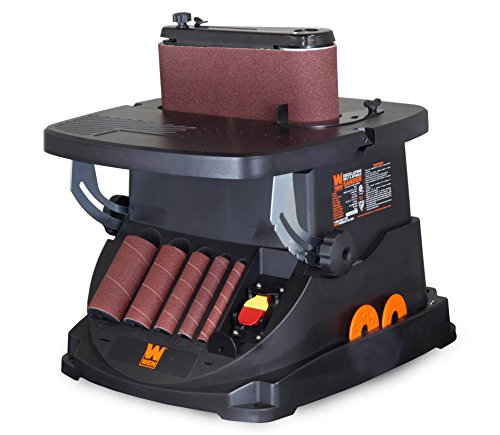
The 6524 is the machine most hobby shops end up with because it does two jobs in one footprint. Swap between five rubber drums (1/2″ to 2″) for curved work and a 4×24″ belt attachment for flatter edges, and the 3.5-amp motor keeps both running at a useful clip — up to 2000 RPM on the spindle and 1575 feet per minute on the belt. The beveling work table tilts for angled sanding, and WEN ships it with five throat plates and six pieces of 80-grit paper, so it’s ready to run out of the box rather than sending you shopping for accessories first.
| ✅ Pros | ❌ Cons |
|---|---|
| • Belt and spindle sanding in one machine • Five drum sizes plus a beveling table cover most curved work • Ships with sandpaper and throat plates included | • Fixed speed — no variable-speed dial • Benchtop only, needs dedicated shop space |
2. Best Value: VEVOR Oscillating Belt and Spindle Sander (2400RPM)
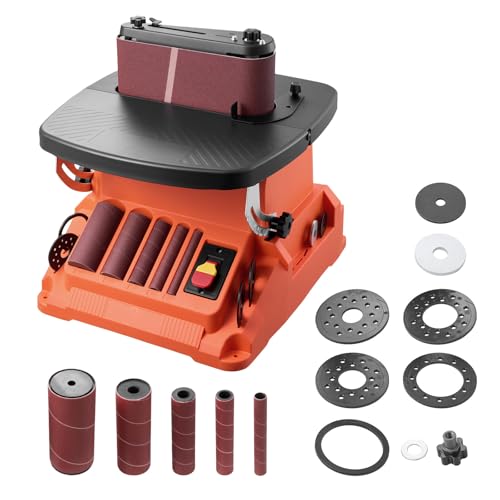
VEVOR’s combo unit undercuts the WEN on price while still covering the same basic job: a 24×3.86″ belt for edges and five sleeves (1/2″ to 2″) for curves, all on a cast worktable that tilts 0–45 degrees. The spindle runs a brisk 2400 RPM, and the dust port steps down from 35mm to 38.6mm so it adapts to more shop-vac hose sizes than some competitors. It’s not going to outlast a contractor-grade tool under daily production use, but for a home shop doing occasional curved trim and furniture work, it’s a lot of function for the money.
| ✅ Pros | ❌ Cons |
|---|---|
| • Lowest price among the genuine belt+spindle combo units here • Tilting 0–45° worktable adds versatility • Adaptable dust port fits multiple hose sizes | • Fixed 2400 RPM — no speed adjustment • Lighter-duty build than the WEN or Ridgid |
3. Best Variable Speed: Woodskil Oscillating Belt and Spindle Sander

If fixed-speed sanders keep burning your workpieces or loading up the paper too fast, the Woodskil’s variable speed control is the reason to step up to it. A 2/3 HP, 4-amp motor gives you 1000–1800 RPM on the spindle and 29–58 oscillations per minute on the belt, so you can slow things down for delicate curves or open it up for faster stock removal. It comes with the same core kit as the other combo units — a 4×24″ belt and five drum sleeves — plus a dust collection belt cover that the others don’t include.
| ✅ Pros | ❌ Cons |
|---|---|
| • True variable speed on both belt and spindle • Dust collection belt cover is a nice extra • Same accessory kit as pricier combo units | • Priced above the WEN 6524 and VEVOR combo • Less established brand track record |
4. Best Heavy-Duty: Ridgid EB4424 Oscillating/Edge Belt Sander

Ridgid EB4424 Sander, Oscillating/Edge Belt
The EB4424 is built for shops that run a sander hard, day after day, not just for the occasional curved cut. Ball-bearing construction backs up both the belt and spindle sides, and switching between the two modes is tool-free — no wrenches, no fiddling with mounting hardware mid-project. Ridgid backs its power tools with a strong service network, which matters more here than on a $50 sander, since this is the kind of machine you expect to keep running for years under real shop use.
| ✅ Pros | ❌ Cons |
|---|---|
| • Ball-bearing construction for sustained daily use • Tool-free conversion between belt and spindle modes • Backed by Ridgid’s service network | • The most expensive combo unit on this list • Overkill for occasional hobby use |
5. Best Premium/Industrial: JET Black 6″x89″ Oscillating Edge Sander

The rest of this list is benchtop combo machines; the JET OES-689-BLK is a different category entirely — a floor-standing industrial oscillating edge sander with an 89-inch belt loop, built to run all day in a production shop. A 1-3/4 HP motor drives a 90-degree tilting sanding head for bevels and flat work, a black-coated cast iron table resists corrosion without waxing, and a 4-inch dust port handles the volume of dust a machine this size actually produces. It skips the spindle attachment entirely and focuses on doing edge sanding at a scale the benchtop combos above can’t touch.
| ✅ Pros | ❌ Cons |
|---|---|
| • Large 89″ belt loop for serious production work • 90° tilting head and corrosion-resistant coated table • Large 4″ dust port matched to the machine’s output | • By far the most expensive pick here, industrial pricing • Floor-standing footprint, not a benchtop machine |
Things to Consider Before You Buy
Belt + spindle vs. belt-only: Most oscillating belt sanders in the benchtop category also include a spindle attachment for curved work, which is why four of the five picks above double as spindle sanders too. If you specifically need a dedicated spindle-only sander instead, that’s a different tool category — check the spindle sizes and RPM range rather than assuming a belt sander covers it.
Stroke length and oscillations per minute: A longer stroke and higher OPM wear the sanding belt more evenly and clear dust faster, which matters most on deep or repetitive cuts.
Table size and tilt: A larger table supports bigger workpieces safely, and a tilting table lets you sand beveled edges without building a jig.
Benchtop vs. floor-standing: Benchtop combo machines suit home and small shops. A floor-standing industrial machine like the JET makes sense only if you’re running a production shop that needs the larger belt length and all-day duty cycle.
Dust collection: Oscillating sanders throw a lot of fine dust. A dust port that matches your shop vac’s hose diameter (check the ID/OD spec) makes a real difference in cleanup and air quality.
FAQ
What’s the difference between an oscillating belt sander and a regular belt sander?
A regular belt sander moves the abrasive in one direction across a flat surface. An oscillating belt sander adds a side-to-side motion that reduces heat buildup, clears dust from the abrasive, and makes it much easier to sand curves and contours evenly.
Is an oscillating belt sander the same as an oscillating spindle sander?
No. A spindle sander uses a rotating, oscillating drum for curved work only and has no belt attachment. An oscillating belt sander uses a continuous belt loop (often with an optional spindle attachment, as with most picks above) and can handle both straighter edges and curves.
Can I use an oscillating belt sander on metal?
Most models on this list are built and marketed for wood. If you need to sand metal, look for a purpose-built metal belt sander with appropriate abrasives, since wood-focused oscillating sanders aren’t designed for continuous metal contact.
Prices and availability shown above are pulled live and may change — always confirm the current price on Amazon before buying.
