
A standard multimeter tells you whether a circuit is live, but it won’t tell you whether the insulation around a motor winding, a cable run, or a piece of switchgear is breaking down before it fails outright. A combination insulation resistance tester and multimeter closes that gap in one tool: apply a test voltage (typically 250V-1000V), read the megohm value, and get standard voltage, resistance, and continuity testing in the same device for everyday diagnostic work. We pulled the current Amazon lineup, checked real-time pricing and availability, and narrowed the field to the 2-in-1 meters that are actually worth carrying in 2026.
As an Amazon Associate, Power Tools Today earns from qualifying purchases. Prices and availability are accurate as of the date shown and are subject to change.
Quick Picks: Best Multimeters with Insulation Resistance Testing
- Best Overall / Trusted Brand: Klein Tools ET600 Multimeter/Megohmmeter
- Best Value (High Range): Megohmmeter/Multimeter Combo, 100GΩ
- Best Budget: GOLDCHAMP 2-in-1 Insulation Resistance Meter
- Best Feature-Packed: AIOMEST VC4060B Insulation Multimeter
- Best Premium/Professional: Fluke 1577 Insulation Multimeter
Quick Comparison: Key Specs
| Model | Price | Test Voltages | IR Range | True RMS | Best For |
|---|---|---|---|---|---|
| 1. Klein ET600 | $191.87 | 125/250/500/1000V | Up to 4000MΩ | Yes | Trusted brand |
| 2. Megohmmeter Combo | $99.99 | 50/100/250/500/1000V | Up to 100GΩ | — | High-range value |
| 3. GOLDCHAMP SK-505A | $55.99 | Up to 1000V | Up to 20GΩ | — | Budget |
| 4. AIOMEST VC4060B | $99.99 | 500/1000V | Up to 2000MΩ | Yes | Feature-packed |
| 5. Fluke 1577 | $840.00 | 500/1000V | Up to 600MΩ | Yes | Professional |
| 6. Extech MG320 | $499.00 | 50-1000V (5 voltages) | Up to 20GΩ | Yes | Mid-premium |
| 7. ennoLogic eM870M | $129.95 | 50/100/250/500/1000V | 50kΩ-2GΩ | Yes | Full feature set |
| 8. UNI-T UT533 | — | 50-1000V | 0.1MΩ-2GΩ | Yes | Extended temp/frequency range |
| 9. KAIWEETS Megohmmeter | $107.99 | 50/100/250/500/1000V | 3MΩ-100GΩ | — | Pass/fail compliance testing |
| 10. 2500V Megohmmeter | $84.59 | 100/250/500/1000/2500V | Up to 50GΩ | Yes | Widest voltage range |
Prices above are pulled live from Amazon and may have changed since — click a model name or the Amazon product card below for the current price.
1. Best Overall / Trusted Brand: Klein Tools ET600 Multimeter/Megohmmeter

Klein Tools has built a reputation on job-site-durable electrical tools, and the ET600 backs that up with insulation resistance testing at four voltages (125V, 250V, 500V, 1000V) up to 4000MΩ, plus standard multimeter functions covering 1000V AC/DC, resistance, and continuity. Automatic-ranging True RMS technology keeps readings accurate on distorted waveforms, and a backlit display with a bar graph, Max/Min, and Hold functions makes it practical for real fieldwork rather than just bench testing. Simple test and lock buttons keep the insulation testing workflow straightforward without digging through menus.
| ✅ Pros | ❌ Cons |
|---|---|
| • Trusted, job-site-focused brand • Four insulation test voltages (125V-1000V) • True RMS auto-ranging for accurate readings | • Priced above most budget and mid-range competitors • Lower max insulation range than some combo meters here |
2. Best Value (High Range): Megohmmeter/Multimeter Combo, 100GΩ

This combo unit punches well above its price on raw measurement range — up to 100GΩ of insulation resistance across five test voltages (50V through 1000V), which covers everything from delicate electronics to heavy industrial equipment. PI (polarization index) and DAR (dielectric absorption ratio) functions give a more complete picture of insulation condition than a single resistance reading alone, and CAT III 600V safety certification plus auto-discharge for capacitive loads round out the safety basics. For its feature set and range, it’s a strong pick for anyone testing a mix of equipment types.
| ✅ Pros | ❌ Cons |
|---|---|
| • Exceptional 100GΩ insulation range for the price • PI/DAR functions for deeper insulation diagnostics • CAT III 600V safety rating with auto-discharge | • Not specified as True RMS • Less established brand than Klein or Fluke |
3. Best Budget: GOLDCHAMP 2-in-1 Insulation Resistance Meter

GOLDCHAMP 2-in-1 Insulation Resistance Meter 20GΩ/1000V
The GOLDCHAMP SK-505A covers the essentials at the lowest price on this list: insulation testing up to 20GΩ at 1000V rated voltage, plus standard multimeter functions for voltage, capacitance, resistance, and diodes. It performs PI, DAR, and timed isolation tests — features usually reserved for pricier meters — and a shockproof silicone shell with an adjustable stand makes it practical for repeated field use. A rechargeable battery with an included charger and carrying bag round out a genuinely complete starter kit for anyone testing insulation occasionally rather than daily.
| ✅ Pros | ❌ Cons |
|---|---|
| • Lowest price on this list • PI, DAR, and timed isolation tests included • Shockproof shell and included charger | • Lower insulation range than the pricier combo meters • Less established brand track record |
4. Best Feature-Packed: AIOMEST VC4060B Insulation Multimeter

The VC4060B goes well beyond insulation testing and basic multimeter functions — it adds capacitance (up to 60mF), inductance (up to 60H), a K-type thermocouple for temperature from -40°C to 1000°C (-40°F to 1832°F), and non-contact voltage detection, making it a genuinely all-in-one tool for HVAC, motor, and automotive diagnostics rather than just electrical insulation work. A 6000-count backlit display and True RMS accuracy keep readings reliable on non-linear loads like VFDs, and the complete kit ships with a carrying case, thermocouple probe, and test leads ready to use.
| ✅ Pros | ❌ Cons |
|---|---|
| • Adds capacitance, inductance, and temperature measurement • Non-contact voltage detection for added safety • True RMS with a large 6000-count backlit display | • Lower max insulation resistance range (2000MΩ) than some combos • More features mean a steeper learning curve for occasional users |
5. Best Premium/Professional: Fluke 1577 Insulation Multimeter

Fluke 1577 Insulation Multimeter, LCD Display, 600 Megaohm Resistance, 500/1000V Voltage
Fluke’s reputation for accuracy and durability carries a price premium, and the 1577 is aimed squarely at professionals who test insulation as a regular part of the job. It combines manual and auto-ranging insulation testing at 500V and 1000V with a full True RMS multimeter, live circuit detection that blocks insulation tests when voltage over 30V is present, and safety certifications covering CAT III 1000V and CAT IV 600V installations. It’s a significant investment next to the budget and mid-range picks here, but for an electrician or technician whose work depends on this tool daily, Fluke’s build quality and support network are part of what’s being paid for.
| ✅ Pros | ❌ Cons |
|---|---|
| • Industry-leading brand reputation and build quality • Live circuit detection blocks unsafe insulation tests • Broad safety certification for professional installations | • Significantly more expensive than every other pick here • Overkill for occasional home or hobby use |
6. Best Mid-Premium: Extech MG320 Insulation Resistance Tester and True RMS Multimeter

Extech sits between the budget combo meters and Fluke’s professional pricing, and the MG320 reflects that positioning: insulation testing across five voltages from 50V to 1000V up to 20GΩ, paired with a True RMS multimeter rated CAT IV 600V and CAT III 1000V for serious safety margin. Auto-ranging, data hold, and min/max recording round out the field-ready feature set, and it ships with a carrying case and test leads included. For a technician who wants Fluke-adjacent safety ratings without the full Fluke price tag, this is a reasonable middle ground.
| ✅ Pros | ❌ Cons |
|---|---|
| • CAT IV 600V / CAT III 1000V safety rating • True RMS accuracy with auto-ranging • Wide 20GΩ range across five test voltages | • Still a significant price jump from the budget picks • More voltage steps to navigate than simpler meters |
7. Best for Full Feature Set: ennoLogic eM870M Insulation Tester/Multimeter
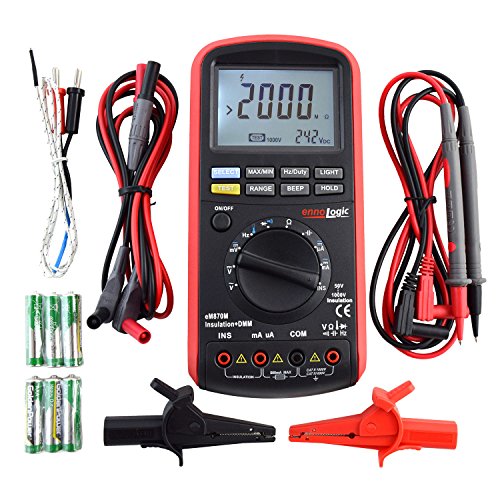
The eM870M packs the most complete secondary multimeter feature set in this roundup on top of its insulation testing — capacitance, frequency, and temperature (via included thermocouple) join the standard voltage, resistance, and continuity functions, insulation tested across five voltages (50V-1000V) with True RMS AC accuracy. It carries a CAT III 1000V safety rating, a 10-year warranty that’s unusually long for this category, and ships with a hard case, two lead sets, and alligator clips ready to go. Reviewers frequently compare it favorably against pricier Fluke models, though it runs on six AAA batteries rather than a rechargeable pack.
| ✅ Pros | ❌ Cons |
|---|---|
| • Adds capacitance, frequency, and temperature to insulation + multimeter testing • Unusually long 10-year warranty • Ships with hard case, two lead sets, and alligator clips | • Priced above most budget and mid-range picks here • Runs on six AAA batteries, no rechargeable option |
8. Best for Extended Temperature/Frequency Range: UNI-T UT533 True RMS Insulation Resistance Tester

UNI-T is an established international test-equipment brand, and the UT533 leans on that with an unusually wide temperature measurement range (-40°C to 537°C) and frequency testing to 1MHz alongside standard insulation testing from 50V to 1000V and True RMS multimeter functions. It’s a newer listing on Amazon with no review history yet, so real-world reliability data isn’t available the way it is for the more established picks on this list — worth factoring in against the premium price, even with a reputable brand name behind it.
| ✅ Pros | ❌ Cons |
|---|---|
| • Established international test-equipment brand • Wide -40°C to 537°C temperature range plus 1MHz frequency testing • Full 50V-1000V insulation test voltage range | • No customer reviews yet, real-world reliability unverified • Premium price for the segment |
9. Best for Pass/Fail Compliance Testing: KAIWEETS Megohmmeter Insulation Tester
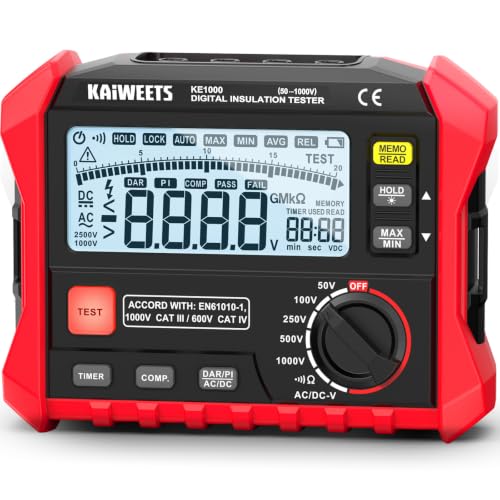
KAIWEETS built this one around documentation and repeatability rather than raw feature count — one-touch DAR/PI auto-calculation skips the manual stopwatch timing older meters require, and a PASS/FAIL threshold alarm with data logging makes it well suited to routine compliance checks on motors, solar arrays, or HVAC equipment where you need a clear record. It covers an exceptionally wide 3MΩ-100GΩ range across five test voltages, with IEC CAT III 1000V/CAT IV 600V-rated housing and 36 months of manufacturer support. The multimeter side stays basic — no capacitance or temperature — and one reviewer noted reduced accuracy below roughly 12kΩ.
| ✅ Pros | ❌ Cons |
|---|---|
| • One-touch DAR/PI auto-calculation, no manual timing • PASS/FAIL alarm with data logging for compliance records • Wide 3MΩ-100GΩ range with CAT III/CAT IV-rated housing | • Basic multimeter side, no capacitance or temperature • Reduced accuracy reported below roughly 12kΩ |
10. Best for Widest Voltage Range: 2500V Megohmmeter and True RMS Multimeter

This budget entry stands out on one spec alone: a 2500V test voltage ceiling, well above every other meter on this list, aimed at heavier industrial equipment that standard 1000V testers aren’t rated for. It covers 100V through 2500V across five settings with up to 50GΩ of insulation range and True RMS accuracy, plus a live-voltage warning icon as a basic safety check. It’s a generic, low-name-recognition brand with a thin review history, and it runs on uncommon 14500 rechargeable batteries that aren’t included — factor in that extra purchase, and treat this as a budget option for the voltage spec specifically rather than a proven daily-use workhorse.
| ✅ Pros | ❌ Cons |
|---|---|
| • Highest test voltage (2500V) of any pick on this list • Up to 50GΩ insulation range with True RMS accuracy • Lowest price among the wide-range options here | • Generic brand with a thin review history • Uses uncommon 14500 batteries, not included |
Things to Consider Before You Buy
Test voltage range: Match the tester’s available test voltages to what you’re actually testing — low-voltage electronics call for lower test voltages, while motors, cables, and industrial equipment typically need 500V or 1000V testing, and heavier industrial gear can call for the 2500V range some newer meters now offer.
Insulation resistance range: A higher maximum range (measured in MΩ or GΩ) matters most for testing high-quality, low-leakage insulation. For routine maintenance checks, a lower-range meter is often plenty.
True RMS vs. average-responding: True RMS meters give accurate readings on distorted waveforms common in motor drives and VFDs. If you’re working around variable-frequency equipment, True RMS is worth prioritizing.
Safety category rating: CAT III and CAT IV ratings indicate how much transient voltage protection a meter offers at different points in an electrical installation. Match the rating to where you’ll actually be testing.
PI and DAR functions: Polarization Index and Dielectric Absorption Ratio tests give a more complete read on insulation condition over time than a single resistance snapshot, which matters more for critical equipment monitoring than for basic pass/fail checks — meters like the KAIWEETS that automate this calculation save time on documentation-heavy jobs.
Related Guides
FAQ
What’s the difference between a multimeter and an insulation resistance tester (megohmmeter)?
A standard multimeter measures voltage, current, resistance, and continuity at normal operating levels. An insulation resistance tester applies a much higher test voltage (typically 250V-1000V) to measure how well insulation resists current leakage — a combo meter does both in one tool.
What insulation resistance reading is considered good?
There is no single insulation-resistance threshold that applies to every motor, cable, or piece of switchgear. Acceptable values depend on the equipment type, rated voltage, temperature, manufacturer guidance, and the applicable maintenance standard. Use the specific limit or trend criteria for the equipment you are testing rather than relying on one universal rule of thumb.
Can I damage equipment by testing insulation resistance?
Most insulation testers include live circuit detection that blocks the test if voltage is already present, and auto-discharge functions to safely bleed off any charge built up in capacitive loads after testing. Always follow the meter’s safety instructions and disconnect equipment from power before testing.
Prices and availability shown above are pulled live and may change — always confirm the current price on Amazon before buying.
